Sergio Busquets less important in Luis Enrique's new, direct Barcelona
Monday 28 November 2016 11:36, UK

Luis Enrique is putting less emphasis on Sergio Busquets - and that could have long-term implications for Barcelona's entire business model, says Guillem Balague.
Sergio Busquets was praised for his performance in Spain's draw with England last week. For fans at Wembley, it was a reminder of his cool, controlled style in the middle of midfield.
Despite a high press from Gareth Southgate's side, Busquets retained possession in tight situations and recorded a passing accuracy of 94.7 per cent.
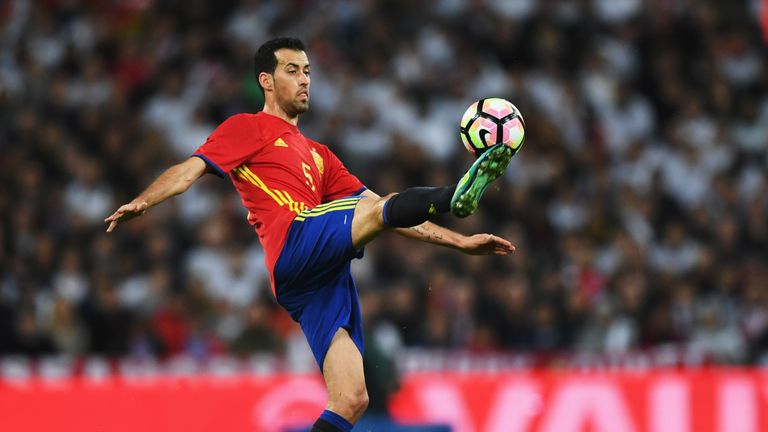
It was the kind of performance he has made his trademark since he stepped up to the Barcelona first-team in 2008.
In September, he signed a new long-term contract with his club, which could keep the 28-year-old at the Camp Nou until 2023.
Barca president Josep Maria Bartomeu has made him one of the highest paid players in the team. It's clear how much Barca value him.
But is that admiration reflected in the way they play?
There's evidence to suggest that Barcelona's shift towards a more direct style under Luis Enrique is reducing Busquets' influence.
Live La Liga Football


He's still an important figure - but the team are no longer playing to his strengths.
Under Luis Enrique, Barcelona look to get the ball to the front three, Lionel Messi, Neymar and Luis Suarez, as quickly as possible. They no longer play so many passes in midfield.
While it has resulted in Messi, Suarez and Neymar scoring huge numbers of goals, it's an approach which can often bypass Busquets.
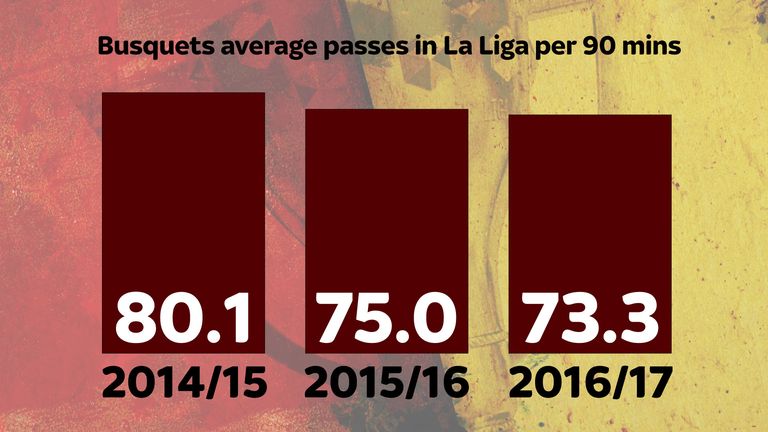
The number of passes Busquets is making reflects his involvement in the game.
Those numbers have steadily decreased over the past three seasons under Luis Enrique's management.
He was making an average of 83 passes per 90 minutes in 2011/12, Pep Guardiola's final season in charge. He's now making just 73.3.
Generally, Busquets remains reliable in possession, as he showed at Wembley.
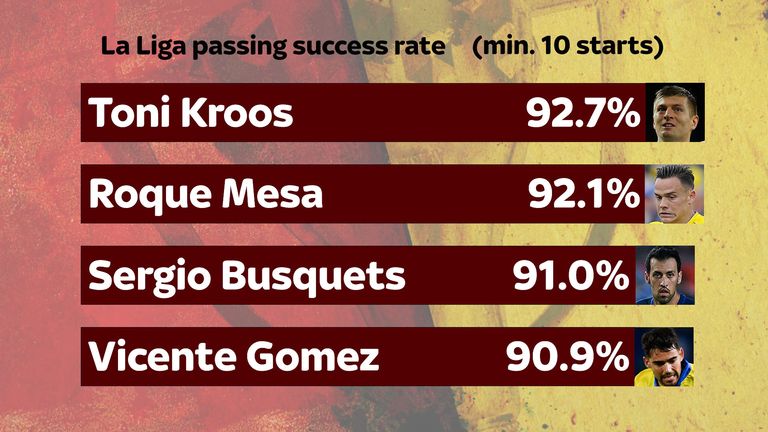
He has a 91 per cent passing accuracy in La Liga this season. Only two players to have played as many games as him have a better average.
But, Enrique's direct approach means there are fewer players around Busquets in the centre of the pitch - and he's increasingly being targeted by opposition teams. Guardiola's Manchester City did this well.
They dispossessed him three times and forced him into giving up possession on another six occasions in their 3-1 win at the Etihad.
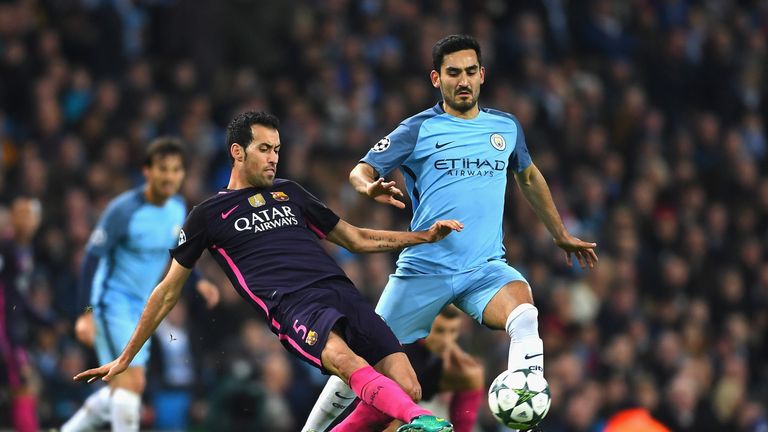
They also closed him off as an option for his team-mates. In the previous fixture at the Camp Nou they restricted him to just 46 touches.
Some La Liga teams have tried a similar tactic.
In Barcelona's defeat to Celta Vigo, his passing accuracy was forced down to 89.8 per cent and he had just 60 touches of the ball.
Alaves, in their win at the Camp Nou, fouled him twice as they harassed him on the ball.
Interestingly, what's going on with Busquets reflects a wider issue at Barcelona.
What's going on with Sergio Busquets reflects a wider issue at Barcelona.
La Masia - the Barcelona youth academy - continues to create teams that need players like Busquets, even if, right now, the first team seems to be veering towards a holding midfielder that can drive the ball with more confidence and turn around quicker than Busquets does.
So what happens when the first team no longer has that fantastic front three they are relying on?
Will they go and buy one of the world's most expensive strikers to replace them? Or will they have to try to revert back to their traditional style?
Enrique's change of tactics and how he uses Busquets has not only affected Barcelona's style, it could also affect the club's entire business model.
Upgrade to Sky Sports now and get 12 months half price. Hurry, offer ends December 4!