
Analysis
Arsenal and Liverpool rank as best and worst from set-pieces as Premier League clubs embrace trend - Between the Lines
Between the Lines takes a look at this season's increase in set-piece goals as Premier League clubs try to give themselves an edge; Arsenal are most effective side, Liverpool least, but what are they doing differently? And where does every team rank?
Friday 16 January 2026 09:38, UK
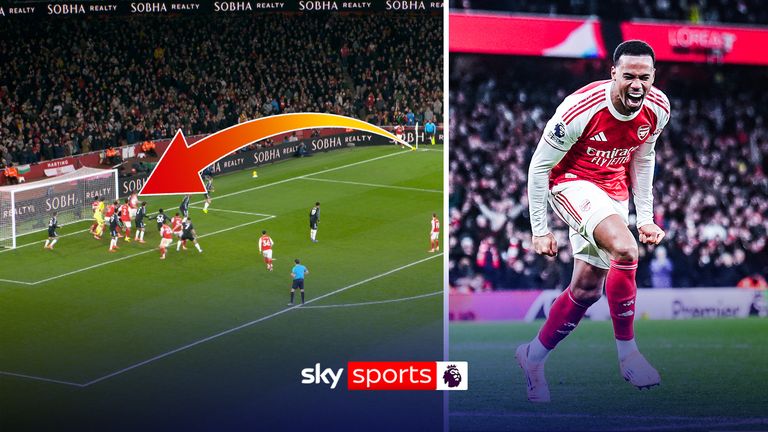
Set-pieces goals are on the rise in the Premier League.
What's behind the growing emphasis on dead-ball situations? And why are some teams excelling and others struggling?
This week's Between the Lines looks at one of this season's defining trends as clubs vie for set-piece supremacy.
- Got Sky? Watch Premier League games LIVE on your phone📱
- No Sky? Get Sky Sports or stream with no contract on NOW📺
How the emphasis has changed
The increase in non-penalty set-piece goals can be seen in the numbers. This season, there has been an average of 0.8 per game, up from 0.6 last term and an increase of roughly 50 per cent from the 0.5 per game average in the 2020/21 campaign.
The inverse pattern can be seen for open-play goals. This season's average of 1.8 open-play goals per game is down from 2.2 last season and 2.4 in the campaign before that.
It is part of a shift of emphasis towards set-piece efficiency. Spurs boss Thomas Frank recently used the term "low-hanging fruit" to describe set-pieces as a route to goal. It is clearly a view shared by a growing number of clubs up and down the division.
Specialist set-piece coaches were unusual as recently as a few years ago. Now, 15 out of 20 Premier League clubs employ set-piece coaches. Brentford even promoted their set-piece coach to the role of head coach when Keith Andrews replaced Frank.
Arsenal have had success with one of the Premier League's most recognisable set-piece coaches in Nicolas Jover. They recently hired former Liverpool throw-in coach Thomas Gronnemark, underlining their commitment to maximising set-pieces.
The specialist coaches are responsible for implementing techniques and devising routines which are honed through practice and repetition on the training ground. Teams are now spending more time on set-pieces during games as well as behind closed doors.
According to Opta, the average number of seconds spent preparing for corners has increased steadily over the last 10 seasons in the Premier League, from 26 seconds in 2016/17 to 36 seconds this term, as players take time to communicate routines.
There has been a similar pattern in time spent preparing for free-kicks, while the time spent preparing for throw-ins has increased even more dramatically this season following the resurgence of long throws up and down the division.
Which sides are most and least effective?
Arsenal continue to be leaders in the set-piece field. The Gunners topped the rankings for set-piece goals, excluding penalties, in each of the last two seasons and occupy the same spot this term, their total of 14 putting them one clear of Manchester United.
Chelsea and Leeds have the next-highest-totals, with 12, while Liverpool are at the opposite end of the scale having only scored three non-penalty set-piece goals, fewer than even the Premier League's bottom side Wolves, who have scored four.
Liverpool's issues are not limited to attacking set-pieces. They are struggling just as badly defensively. Their total of 13 set-piece goals conceded this term is the joint-second highest in the Premier League behind Bournemouth, on 14.
The result is that while Arsenal sit top for net set-piece goals on nine, having only conceded five to the 14 they have scored, putting them just ahead of Spurs, who have improved considerably in the area under Frank, Liverpool sit bottom on -10.
Inswingers vs outswingers
So what do Arsenal and Liverpool do differently?
On corners, there is a significant difference in delivery type.
Inswinging corners are statistically more likely to lead to goals but Liverpool have taken the lowest percentage of inswingers in the Premier League this season at 48 per cent. Arsenal, by contrast, have one of the highest percentages, at 81 per cent.
This season in the Premier League, there have been 77 goals from inswinging corners, according to Opta, compared to only 11 from outswinging corners.
The difference is partly down to a higher volume of inswingers compared to outswingers. But inswingers have a higher success rate too, with 5.3 per cent of inswingers leading to goals this season compared to only 3.6 per cent of outswingers.
Leeds appear an anomaly given they rank joint-third for set-piece goals despite having taken an even higher percentage of outswinging corners than Liverpool, but it is worth noting their last four corner goals have in fact come from inswinging deliveries.
Spurs are another side enjoying success with inswingers. They have an even higher proportion of inswinging deliveries than Arsenal at 83 per cent and rank as the only side with a better corner conversion rate than the Gunners, as per the graphic below.
By using inswingers, teams are able to target the six-yard box, putting opposition goalkeepers under direct pressure and generating close-range chances from flicks and headers.
The trajectory of an inswinger also opens up the possibility of scoring directly from a corner, as done by Newcastle's Bruno Guimaraes against Burnley in December.
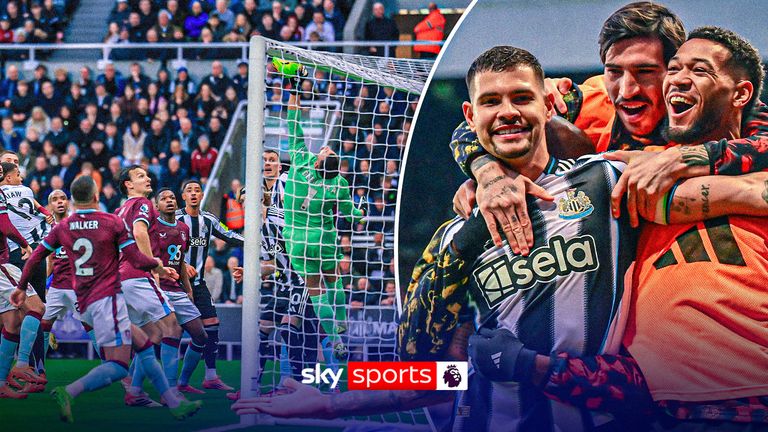
Targeting the six-yard box with inswingers continues to pay off for Arsenal, most recently in their 3-2 Carabao Cup semi-final first leg win at Chelsea, when Ben White headed the opener from an inswinging Declan Rice delivery.

The most recent Premier League example came from the other side, when Bukayo Saka's centre was bundled over the line by Gabriel from a few yards out during the 4-1 win over Aston Villa.

There is a big contrast in Liverpool's corner delivery locations.
While Arsenal have sent 58 per cent of their corners into the six-yard box, Liverpool have only hit the six-yard box with 36 per cent of theirs. A much higher proportion land further away from goal, and therefore in less dangerous areas, due to their use of outswingers
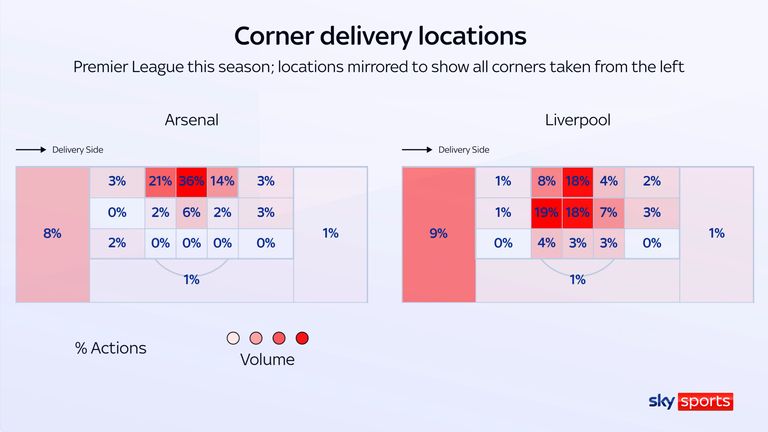
It is a factor which helps to explain Arsenal's superior set-piece scoring record. Meanwhile, Jamie Carragher has put Liverpool's issues defending set-pieces down to a zonal marking system which leaves too much space to opposition players.
Analysing Harrison Reed's long-range equaliser for Fulham earlier this month, a goal which came from a throw-in situation, he said on Sky Sports' Extra Time: "It just felt to me that it was far too easy to get a shot in on the edge of the box.
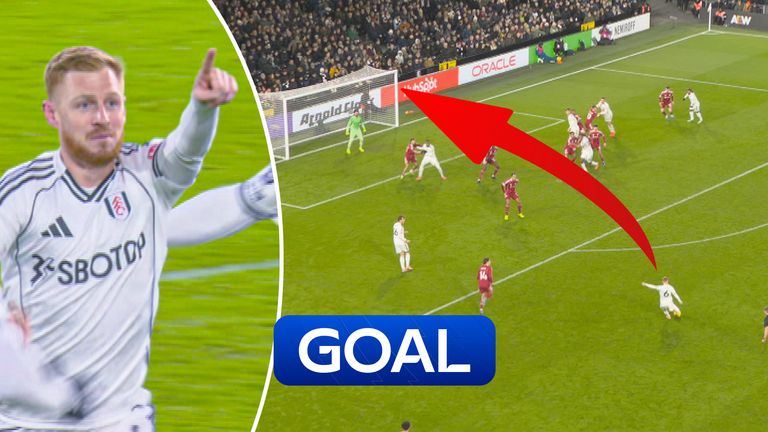
"What Liverpool like to do on set-pieces is man-to-man mark, and also have three players in a zone. What that means is, there's an overload outside of the box."
Fulham ended up capitalising on that overload in spectacular style but the issue has been apparent all season, with the vast majority of the set-piece goals Liverpool have conceded coming from second balls dispatched by opposition players in space.
The extent of the issue can be seen in the fact that only one Premier League side, Crystal Palace, have conceded a higher percentage of goals from set-pieces than Liverpool this term.
Who are the real long-throw specialists?
Long throws have been adopted by the majority of Premier League teams this season. The average has more than doubled to nearly four per game. But which clubs use them most effectively?
Brentford have launched the most long throws this season, becoming the first side to reach 100 for the campaign during their 3-0 win over Sunderland last weekend.
Their use of long throws is not new. The Bees were early adopters. This season, their throws have led to three goals, the joint-most in the Premier League along with Crystal Palace and Sunderland.
Interestingly, though, it is Leeds, not Brentford, Palace or Sunderland, who rank top for shots and expected goals from long throws, suggesting they are the most dangerous.
Daniel Farke's side have only scored twice from long throws this season but, from a total of 75 long throws, they have managed 28 shots worth 3.46 xG, compared to Brentford's 27 shots worth 2.73 xG from 100 long throws.
It is just another area in which Premier League teams are scrambling to find an edge as the trend towards set-pieces continues.
Read last week's Between the Lines
Before Michael Carrick's appointment as head coach, we looked at which managers best fit the fabled Man Utd 'DNA' using a stylistic profile of Sir Alex Ferguson's 2012/13 title-winners. Carrick ranked pretty highly but which former Chelsea boss came out top?