Cadiz aiming for La Liga by leveraging technology and tourism in the search for an edge - via the American stock market
How Cadiz are finding an imaginative way to reach the top division in Spain - and stay there. Adam Bate speaks to the key men to find out about their subsidiary launching on the United States stock market and what the ambitious venture might mean for the club...

Friday 20 February 2026 10:36, UK
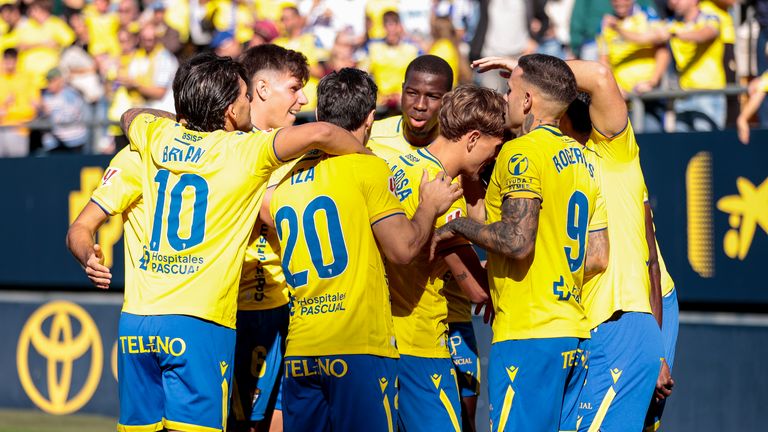
Cadiz are not exactly giants of Spanish football. “We are not a rich club,” vice-president Rafael Contreras tells Sky Sports. “We are a club of the street.” But this is encouraging them to think outside the box to succeed. “We must discover new ways to be great.”
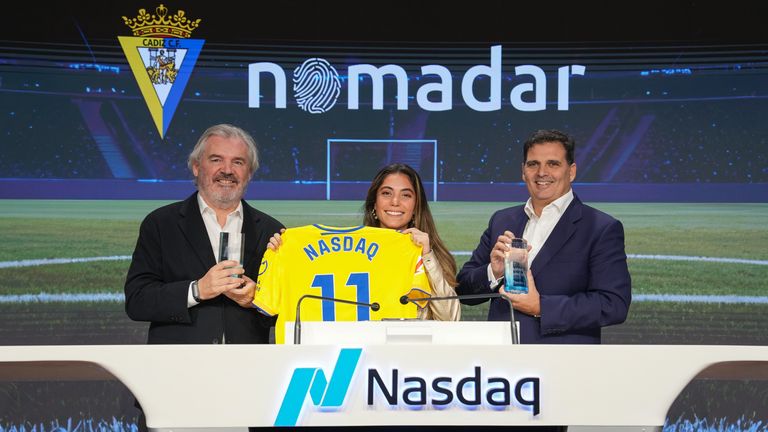
Earlier this season, the club made history in Spanish football when Nomadar, a subsidiary of Cadiz, launched on the US stock exchange. The plan is to expand their interests to help the club become a powerhouse in the south, a true force in La Liga.
It is an ambitious goal. "Let's call it a revolution," Joaquin Martin Perles tells Sky Sports. Perles is chief executive of Nomadar's operations in the Americas, leveraging their investments in technology and real estate. "It is a different model," says Contreras.
Plans are already afoot. There is a five-year lease with an option to buy over 100,000 square metres of land as part of the Sportech City project. They want to help turn this part of Andalusia into a hub, using the funds generated to grow Cadiz like never before.
Cadiz's long history does not hint at looming greatness. The club did not play in La Liga until 1977, although there are fond memories of their relative glory years in the 1980s. The great 'Magico' Gonzalez, a personal favourite of Diego Maradona, is still a cult hero.
But the point is that there is potential beyond those beautiful yellow shirts. An average attendance of a shade over 14,000 is an indication of that but the key advantage that Cadiz hope to leverage now is the attractive location of the city in coastal Andalusia.
Cadiz has certain climactic advantages. Southern Spain has long been a destination for professional clubs as a training base. "We have 300 sunny days per year so the possibilities are there," says Perles. Cadiz want to do rather more than just play host.
The vision is for young players from around the world to join their high-performance training program and be schooled in the Cadiz methodology. "It is for kids aged between 12 and 18, coming to Cadiz to live, study and train, integrating them into our club."

Not all of them need to be elite players. Indeed, the success hinges on expanding it to all. Some, such as those from Ecuador, are earmarked for their potential to bolster the Cadiz first team in the future. Others from Asia and America might pay for the privilege.
"They pay for accommodation, for food, for training, for studying and so on. We have players come for a month and two in the summer and then leave." But by making their training methods accessibly remotely, Cadiz see an opportunity to scale this model.
"They all want to retain access to the same elite training methodology. That is where the scalability comes in. These players are maybe not going to play for Cadiz but they are still able to train at the level of a team from LaLiga, wherever they are in the world."
If Cadiz can pull this off and turn their training camps into a model that is used around the world, it would be transformative. They do not boast the name recognition of Barcelona or Ajax but by being at the technological vanguard, they see possibilities.
For example, the quest for an edge extends to injury prevention - and that goes beyond football. "Do you play golf?" asks Contreras. "If you have a problem with your knees, we are working on technology to prevent it, a different movement when you hit the ball."
Perles continues: "With our program, we can apply a specific exercise to reduce injury and improve performance. We are taking all that knowledge, collecting all that data, to focus on injury reduction. We're doing it right now, obviously with football the priority."
When the powerbrokers at Cadiz talk of operating 'at the intersection of sport and tourism' it is easy to wonder how all this will actually impact the club currently halfway up the table in Spain's second tier. The conviction is that this is a long-term vision.
It is about transforming potential, tilting the odds in their favour. The ambition is to become a hub for talent and in doing so have eyes directly on more players, all of them assessed and compared based on Cadiz's own metrices, a unique scouting advantage.
This could become part of the club's identity too, amplifying the brand, turning Cadiz into a magnet for talent around the world, a landing point for players in Europe. Others sense that it could offer a competitive difference - they have told Contreras as much.
"I have had teams from all around the world asking me about the project. They are paying attention because all clubs are looking to generate revenue," explains Contreras. "The big picture here is to serve the first team, to make us stronger, more competitive."
"I know that the fans will only be happy if we win on the field. So, they are excited about the future, excited that we are developing the project. But every week they are either happy or sad depending on tour results. The mood changes every day. That is football."

You have that feeling that you are doing something that has never been done before.
They hope that this will be that way, even if it is a step into the unknown. "You have that feeling that you are doing something that has never been done before," says Perles. It has captured the imagination, Contreras says, even if there is still some scepticism.
"Today, all of the city is talking about it. Before, nobody knew anything about the stock market. Now, they want to put a NASDAQ office in the city centre. The joke is that in the cafes they now talk about the markets the way they would talk about a new striker."

Whether this bold idea actually works is no more guaranteed than the goals of that new striker, but Cadiz are trying something different. Ultimately, that is the point, isn't it? A novel plan was better than no plan. Business as usual was no longer an option.
"In our 116 years, we have been in the top division for 16 of them," says Contreras, putting the plans into context. "The vision is to generate more revenue to increase the club's level so that we can be in the middle of the first division." A new way to be great.