Skip to content

From Bolton to NYC

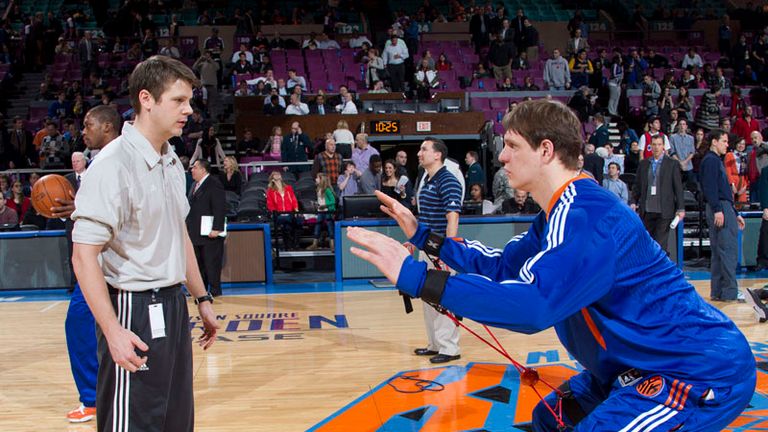
Image: Barr (l): Works with Timofey Mozgov (Credit: Dave Saffran/MSG Photos)

Ian Watson meets Andy Barr to hear how NBA life differs from his roles at Bolton, Saints and Man City.

Ian Watson meets Andy Barr to hear how NBA life differs from his roles at Bolton, Saints and Man City.

Andrew Barr is one of the rarest of species - an Englishman working in the NBA. The former professional footballer plies his trade as a performance specialist for the legendary New York Knicks, but his journey to the Big Apple began in the less-glamorous surroundings of Luton Town. Between departing Kenilworth Road and arriving at Madison Square Garden, the 31-year-old made stops at Bolton, Southampton and Manchester City, In our interview, Barr gives Watson a unique insight into two of the world's richest leagues and how life in the NBA compares to working with the likes of Sam Allardyce, Mark Hughes and Clive Woodward. IW: 'Performance specialist' sounds like a very broad title. What exactly is your role within the Knicks organisation? AB: My key role is to look at injury prevention strategies, to try and keep the players in optimal health and then optimise their performance. My job now is about being proactive and working with the players who are fit to try and stop them getting injured, whereas in the past, it was all about managing the players who are injured and getting them back on the field. Working with [ex-Chelsea, Leeds and England physio] Dave Hancock, we track the intensity of every practice and we can see whether the players are working hard enough to maintain fitness or whether they are doing too much. Are performance specialists or injury-prevention specialists commonplace at most clubs and teams? It's quite unheard of, there aren't many teams around the world that have someone in a specific role for it - but it is really important. When I joined Man City in 2009, I was one of the first people in sport to be given the role of injury-prevention specialist. As a sports science and medical team, your primary goal should be injury prevention - keeping the best players fit and healthy, and secondly, to optimise their performance and athletic potential. But a lot of teams get that the wrong way around. There is too much focus on performance development and not enough consideration to injury-risk prevention. Then the players get injured, and they have to try and get them fit again. Where did your journey to the Knicks and the NBA begin? I started at Luton Town when I was nine years old and went through the youth system before doing a year's pro. I had a few serious injuries, though, and I knew I needed something to fall back on, so I was fortunate to get a place on a physio course through the PFA, who have a great support system for people who don't make the grade fully. That eventually led to me getting the position at Bolton. You spent seven years at Bolton during an exciting time for the club. The Trotters were often labelled as 'pioneers' when it came to application of sports science in the Premier League. Is that fair? Absolutely. I was so fortunate that in the first job I went into, I was surrounded by these inspirational people that wanted to lead the way. The thing with Bolton was, we didn't have the players to compete at the top of the Premier League in terms of skill and technique because of the finances. But we could be equal in terms of optimising athletic potential, because we realised a lot of teams weren't doing that. We might not have been able to improve the players much from a technical point of view, but what we can do is make them fitter, stronger, quicker and keep them healthier. At one stage we had the oldest team in the league but we had the best injury record, for quite a number of years. Bolton went from being relegation candidates to competing in Europe. A lot of that success came from the belief that Sam Allardyce installed and we were basically a family. We were a force that was unstoppable. Allardyce is still seen by many as being an old-school manager and a long-ball merchant. Is that at all accurate? No. Far from it. Sam always said the only type of football he played was winning football. You can call it what you want, but the way to win is to utilise everything you can. Attention to detail was key with Sam, he was a very, very smart guy - one of the best I've ever worked with. He was very receptive to new ideas and although his style of football might not always be great on the eye at times for some people, it is effective football. To say he was old-school is just really ignorant. The way he plays is a different style, but what do you want to see: a team who plays great fancy football but is in the bottom two, or a team that's winning every week? It might not be that fancy, but it's effective and brings a lot success. What made you decide to leave such a fantastic set-up at Bolton and drop a division to join Southampton? Sam was in the running to get the England job, - it was a crying shame he didn't get that chance - and I needed a new challenge. I was 27 and knew I had to go and lead my own department. I got offered the position at Southampton and I wasn't sure how much longer Sam was going to be at Bolton or how much more he could achieve there, so I thought this was a great opportunity for me, especially to work with Clive Woodward. Southampton's appointment of Woodward raised a few eyebrows in the football world. How did you find working with the former England Rugby Union coach? Clive was trying to set something up at Southampton like he did with England Rugby in terms of having every area covered. He wanted to set up something really special. He was a smart guy, he knew there were so many other areas you could improve on, not just skill. He wanted to build up this team of experts and consultants. He brought in some of the best nutritionalists, he had a person that came to help with visual training - he really thought outside the box. Clive was only there for five or six weeks while I was there, which was unfortunate as I know we could have developed something really special. Given he had no background in football, how was Clive accepted by the staff at Southampton? Clive didn't want to step on anyone's toes in terms of coaching, but he wanted to lend his expertise to the manager as much as possible in other areas where the manager didn't excel. Some people loved him, but sometimes because he wasn't a football person, some people can be very sceptical. I had a lot of support, though, from the board and the manager who really saw the benefit of sports science and medicine. Once we got the basics in place, we really saw the benefits. We cut the non-traumatic and preventable injuries by, I think, 45-50 per cent in one season and came within a penalty shoot-out of the play-off final. After Southampton, you returned to post-Allardyce Bolton when Gary Megson brought you back. Given his reputation as a traditional, no-nonsense manager, how did you find working with Megson? Sammy Lee took the job at a difficult time after Sam Allardyce. There were a lot of people leaving - it was turmoil. Sammy had tried to change a few things but when Gary arrived and it's quite funny; his exact words were, "why are we trying to change something that's not broken? We have to do the things that have made Bolton successful'. Everyone was quite shocked at that as he didn't have the reputation of being somebody who was pro-active or forward-thinking. The players wanted people back who knew the system and Gary said he wanted to implement all the old systems again. I don't know if he was paying me lip service, and paying the players lip service to win them over initially, but I think that's what he did. Basically, when a couple of results went the wrong way, he went back to his old methods and his old-school approach. We just stayed up that season. You arrived at Manchester City shortly after the takeover. Did City's backroom operation see much of the cash that was flying around Eastlands at the time? It was awesome; there was nothing you couldn't really get. Every area was fully-funded and everything you asked for, you pretty much received in terms of new equipment and technology. There were so many fantastic things that were put in place for the players. I was really lucky to work with so many great people and Mark Hughes was fantastic manager. You moved to the USA shortly before Hughes was replaced by Roberto Mancini. Some people have been quite outspoken about the new regime and about how the increase in injuries at City coincided with changes to the training pattern and programme... Yeah, 100 per cent. Weirdly, a lot of the old Bolton staff were working at City at the time, but we were doing things even better than how we were doing at Bolton. Mark Hughes was really receptive and we had Raymond Verheijen [now Wales assistant manager] - a specialist in terms of periodisation and player training and his record spoke for itself in terms of injury prevention and the success with the teams he had been involved with, such as Barcelona and Chelsea. We had that in place alongside some other great systems. We were really scientific and methodological and had a huge influence on the players' training programmes in terms of the intensity. The players' fitness was phenomenal and our injury record was the best in the Premier League. But like so often happens, a new manager comes in and he's not comfortable with the staff that are in place because they are part of the old regime. They want to do things their own way and do what's worked for them so all the positive influences that the sports science and medical team had in terms of the training, I think, were really taken out of the equation.