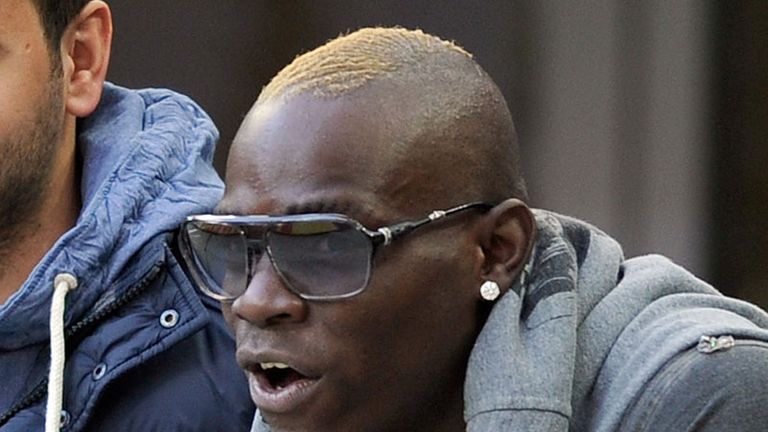
Kait Borsay takes a look at whether the new 'bad boy' of the Premier League will ever turn for the better.
When Mario Balotelli admitted to Italy coach Cesare Prandelli this week that he "needed help" he recognised that he'd blown any chance he had of a fresh start in the game since rolling in to Eastlands last August
Kait Borsay takes a look at the man behind the 'Super Mario' tag and wonders whether the new 'bad boy' of the Premier League will ever turn for the better.
Born in 1990 to Ghanaian immigrant parents in Palermo, Sicily, Mario Barwuah was adopted by the Balotelli family at the age of two and moved to Brescia. Even at a young age his football skills didn't go unnoticed, and at the age of 11 he was picked up by local side AC Lumezzane. Thanks to a special exemption (where a player has to be 16 to play in the division) he became the youngest person to play in Serie C at the age of 15.
After a five-day trial he nearly moved to Spain to join Barcelona when he was 16 - but problems trying to get a work permit meant the deal fell through and instead Balotelli joined Inter Milan. Soon progressing to the Primavera (under 20) team he won the Scudetto in the 2006-2007 season and the 2008 Viareggio Youth Tournament.
Aged seventeen he made his first team debut for the Nerazzurri under coach Roberto Mancini in December 2007. In 59 appearances the striker scored 20 goals.
In August 2010 soon after Rafael Benitez arrived as coach at Inter, he let the player leave to rejoin Mancini at Manchester City, for a fee of £24 million.
In his time at Inter Milan, the team won three Scudetto, the Italian Cup, the Italian Super Cup and the Champions League.
There's no doubt he has exceptional talent: after making his Serie A debut Balotelli won plaudits on the pitch for scoring two goals against Juventus in the return leg of the Italian Cup quarter-finals, helping Inter win 3-2. Coming on as a substitute for Luis Figo in the 2008 Italian Super Cup final against Roma he rescued a goal for the Nerazzurri, who went on to win the trophy after the match ended 2-2 and Inter got the better of the penalty shoot-out.
Petulance
But what has gained Balotelli most of the headlines, certainly in recent years, is his professional petulance and often bizarre behavior off the pitch. As a younger player perhaps he'd always suffered from a spoonful too much of arrogance, but no longer a teenager, he's not protected anymore, and it's time for him to grow up.
Some of his most notorious fallouts were with Jose Mourinho, during the now Real Madrid boss' tenure as head coach at Inter from June 2008 to May 2010. Two egos never work well together and the pair had several run-ins. The player was accused of being lazy in training and was later excluded from the team in the second half of January 2009, Mourinho saying:
"As far as I'm concerned, a young boy like him cannot allow himself to train less than people like Figo, Cordoba and Zanetti."
Along with his fellow players he was publically criticised by Mourinho after a poor league draw with Roma in November 2009, Balotelli singled out as "close to a zero rating".
Tensions reached their peak when the pair were reportedly embroiled in a spat at training before Inter's second leg against Chelsea in the Champions League in March 2010 which resulted in the forward being omitted from the squad for disciplinary reasons. Despite winning the tie, several senior players at Inter lambasted the 19-year-old's behaviour.
Never one to think before he acts, 'Super Mario' then publically sported an AC Milan shirt on an Italian TV show. He had to release a statement of apology to his club's website for that one.
Already on the wrong side of the majority of Inter's fans he came a cropper in the Champions League once again, this time in the semi-final against Barcelona in April 2010. Having been booed in the game for his poor performance he threw his shirt on the ground after the final whistle, even though Inter had won the game and was again the subject of much disapproval from fans, team-mates, press and pundits. This led to the inexcusable attempt by a small group of Inter supporters to physically attack Balotelli after the game.
After making the move to rejoin Mancini in England, Balotelli had this to say of his former coach at Inter:
"Mourinho is the best coach in the world, but as a man he still needs to learn manners and respect. [Roberto Mancini] is the most important coach I've ever had. He'll soon become the number one in the world. But already now, in terms of human qualities, he is two kilometres ahead of Mourinho. Wait, make that 10 kilometres."
Stupid
His arrival in the Premier League has already seen the player earn two red cards, despite not making his debut until October 2010 because of injury. Whilst Mancini felt the first sending off was harsh (when Balotelli was sent off for violent conduct for a clash with Youssuf Mulumbu in Man City's 2-0 win against West Brom, after the player had scored both of his team's goals) the second was to have much harsher consequences.
Earning himself a first-half red card against Dynamo Kiev in the second leg of their Europa League tie was always going to be a "stupid" (said Mancini) idea, but effectively ending your side's chances of progressing to the quarter finals is going to cost them a missed opportunity.Balotelli might insist that his chest-high tackle on Kiev's Goran Popov was not intentional - but if that's the case he needs to grow up, or get cleverer. The player was fined two weeks' wages and dropped to the bench for the Chelsea game a few days later. He was also excluded from the Italy squad to play Slovenia in this week's Euro 2012 qualifying match.
This is not a pattern of behavior that's going in the right direction. Italy coach Prandelli has heard from the player who seems to be full of remorse.
"He understands that he made a fool of himself. He said to me: 'I need help. I always ruin everything, but I care a lot about the national team'." I'm sure City fans will be delighted.
Balotelli's agent Mino Raiola has called for patience. "He will come out stronger than ever, it is part of his development. We need to support him." Then the media got a bit of stick.
"The British press make everything a drama, whatever he does is magnified, but he will emerge stronger," Raiola said. "He is a good guy but he is also under the magnifying glass."
Goodness. We've never heard that one before. I can't help remembering that this has been said of a player who openly stated "England is far ahead of the rest in terms of stadia and far behind in terms of its media. The newspapers are just trash."
Inter Milan president Massimo Moratti has perhaps called the situation a little better. Speaking to Sky Italia he said "it's just his personality. In life you can change everything, but it's very difficult to change your personality." He added "having said that, this personality also has positive aspects, such as the constant motivation to battle and prove himself."
He claims a meeting with his idol and former Inter player and Brazil international Ronaldo would bring about the changes he needs to make, but you can't just hand over the responsibility needed for reform so easily to someone else.
For much of his time at Inter, Balotelli was subjected to racial abuse during matches, notably from Juventus fans, and not always when they were playing his team. Juventus were punished several times for various incidents and it can't have been easy for the player. There's no debate that racism in the game is unforgiveable - there are some times though, where you just have to let your game do the talking.
Unprofessional
On the pitch footballing misdemeanours are just unprofessional - in a physical game there's a huge risk that intentionally or not, frustrations will be realised in a physical way. Players can't just calm down by having a ciggie outside the office with a workmate - bad language is readily accepted, but the target of your frustrations will either choose to, or will need to jog on and get on with the game - therefore nothing makes a point quite like a dangerous tackle. It's those footballers that are unable to keep a lid on it, who let emotion override professionalism that will fall foul.
Verbally he's hardly generous to other footballing professionals either. After winning the Golden Boy award in 2010 he said:
"Who else would have won it other than me? There is only one [of the former winners] who is a bit stronger than me - Messi. All of the others are way behind me."
He then claimed to know nothing of the runner-up, Jack Wilshere.
"What's he called? Wil...? No, I have not heard of him yet, but the next time I play against Arsenal I will have to pay attention. Maybe I could show him the Golden Boy and remind him that I won it."
The controversy doesn't just end when Balotelli leaves the training ground or the stadium - there's the time he crashed his Audi R8 and police demanded to know why he was carrying £5,000 cash. "Because I am rich," he said.
There's the time last October when out with injury the player and his brother tried to gain entry to a women's prison in Brescia.
Prison officer Calogero Lo Presti explained: "It was 4pm when we saw a high-powered Mercedes come through the gate. Inside were two boys, after a few minutes we realised one of them was Balotelli.
"Physically we recognised him, but that is not enough, so we proceeded with official procedure. At the end they both appeared a bit frightened. They said they saw the gate opened and never imagined they would need a special permit to visit the prison. The two were particularly intrigued by the fact it was a women's prison."
A lot of footballers make bad choices off the pitch - look at Frank Lampard, Rio Ferdinand - the difference is most grow up and move on. Fingers burnt, they rarely make an error of that magnitude again. Footballers attract controversy like flies to a pot of jam - they can't afford to court trouble, and the sooner that penny drops the better. It isn't a case of whether it should be like that or not. It is what it is for footballers with the potential to make it big - and they need to get on and deal with it.