With football agreeing to use goal-line technology we looks at how various sports have utilised technology.
With the football authorities agreeing to use goal-line technology to assist referees, we look at how various sports have utilised technology.
FOOTBALL
The global game has been one of the most reticent to embrace technology but it has been used in some forms. Replays are used by national associations for disciplinary reasons post-match. Referees and their assistants also use earpieces and microphones to aid communication during games. The use of replays in matches has always been a step too far for the game but many cynics believe France's Zinedine Zidane was only sent off in the 2006 World Cup final after TV highlighted him butting Marco Materazzi.
CRICKET
The third umpire was first introduced in international cricket 20 years ago, primarily for on-field umpires to call for assistance for run-out and stumping decisions and whether catches had carried to fielders. Over the years the remit has been expanded as technologies have advanced, with third umpires now having access to super-slow motion, infrared imaging, stump microphones and the predictive ball-tracking 'Hawk-Eye', which can rule on lbws. Players can now challenge umpires' decisions by calling for a TV review.
TENNIS
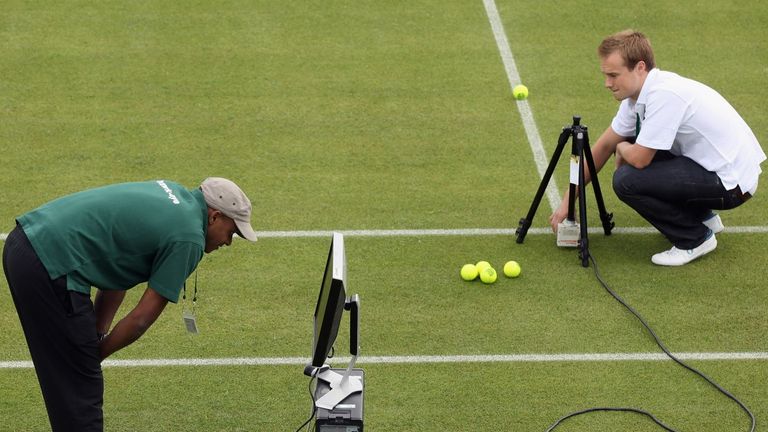
Wimbledon watchers will remember the bleeps of 'Cyclops', the infrared system which was used to detect whether serves were in or out and was introduced at the championships in 1980. These days the showpiece matches utilise Hawk-Eye, which tracks the ball all over the court. If a player disagrees with a line judge's call, they can call for a Hawk-Eye review and are allowed two incorrect challenges per set.
RUGBY LEAGUE
The video referee came into rugby league with the launch of Super League in 1996 and has become part of the competition's fabric, although it is still only used in live TV matches for cost reasons. The system has been refined over the years but the video referee can rule on a wide range of decisions when called upon by the referee, with the exception of the forward pass, for which camera angles can be deceptive. The system is also used in televised Challenge Cup ties, Australia's NRL and selected international fixtures.
RUGBY UNION
The 15-man code paved the way for the introduction of the Television Match Official in 2001. They are now regularly used at the top level but their scope remains limited with referees only able to call for assistance in acts of scoring. That could change later this year with the International Rugby Board having approved trials for reviews on other matters within the field of play.
Since last season the TMO has been used in all English Premiership games, not just those being televised.
AMERICAN FOOTBALL
The NFL introduced a replay system in 1986 with an extra official used to review certain plays. It was dropped in 1992 amid general feeling it had done little to improve the game but a new method of coaches' challenges was brought in seven years later. When a challenge is made in the NFL, it is the on-field referee himself who will watch replays, under a hood, on the sidelines. He must see clear evidence of an error and has 60 seconds to make a decision. Coaches are allowed to challenge two decisions per game but if both are successful are allowed a third. If a challenge is unsuccessful, the team is charged with a timeout. Challenges cannot be made in the final two minutes of each half, or overtime, but all plays are observed by an additional TV official.