
Sky Sports' David Tanner dissects Scotland's Euro 2016 exit
Saturday 17 October 2015 16:07, UK
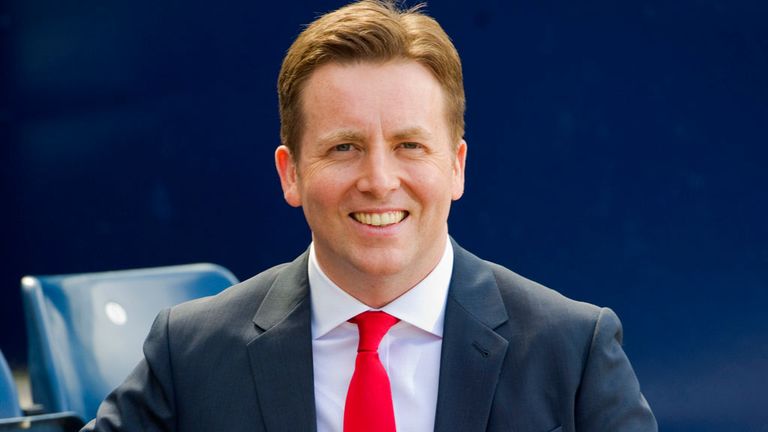
David Tanner discusses the return of the SPFL following the international break and, after the disappointment of Scotland's European Qualifier campaign, urges Gordon Strachan's men to follow what Jurgen Klopp told Liverpool and switch from being "doubters to believers".
I was interested to read Sir Alex Ferguson apportion some of the blame for the problems in Scottish football on the Margaret Thatcher Government's spat with the Scottish schoolteachers back in the mid-1980s.
I belong to the generation that was at secondary school during that period of industrial action; my peers and I regularly went without schooling on Tuesdays and Thursdays (the unions' preferred days for action). The leader of the largest teachers' union, the EIS, was John Pollock who became as familiar a face in the Scots media as Sir Alex, then boss of both Scotland and Aberdeen.
The industrial dispute centred on how the Government planned to implement some of the recommendations from the Munn & Dunning reports on the future of the state schooling system in Scotland. In his new book "Leading", Sir Alex reflects on effects of the strike: "Following an industrial dispute with the Government many teachers stopped organising extra-curricular sports activities. It had disastrous consequences."
The age-old tradition of the school football team disappeared overnight in Scotland. Move forward 15 years to when the secondary school pupils of the mid-80s were the experienced players in the international side, the problems with reaching tournaments really begin to manifest themselves. The footy magazines I remember reading as a kid profiled players every week and asked them questions about their likes and dislikes eg favourite car (usually a Ford Capri), favourite food (always steak and chips), favourite singer (never The Nolan Sisters), bad habits (often smoking) and dislikes about football (the reply to that was generally "losing" or "smoking").
The question that always caught my eye was: "biggest influence on career?" The answer was generally: "Mr So-and-so who took my school team". These teachers (who very often taught subjects from outside the PE department) were coaches and mentors but most important of all they provided a structure which allowed pupils to play and to learn. And more than a touch of discipline. Playing for the school taught people to take pride in the jersey and to win. And all that was lost. How many players were lost to the game because of the death of the school team? How many suffered arrested development? Not even Sir Alex could answer that accurately.
But here's a suggestion. Rather than looking back in anger, wouldn't it be a positive for Scotland if our teachers and politicians made the effort to create conditions which would permit the reintroduction of school teams? Mrs Thatcher left Downing Street in 1990 and education has long since been devolved to the Scottish Parliament. There's nobody else to blame now. Scotland's failure to reach another tournament has cost the nation's economy countless millions - it's more than just a team sport - it's a numbers game. The SFA's technical departments were found wanting at this time when ideas and action were in short supply.
In recent years, schools across the UK have seen great investment in sports facilities. In the west of Scotland, for example, that means many of those awful red blaze/ash pitches have been consigned to history and been replaced by 3G surfaces. If you don't know what red blaze is - you're lucky!
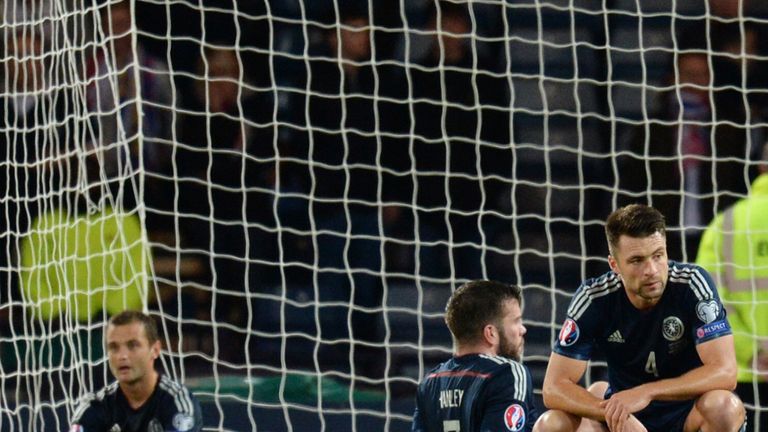
In the immediate aftermath of Scotland's late collapse against Poland, I stumbled across a post by former-SPL chief executive Roger Mitchell, now a successful businessman in Italy. Roger is still a supporter of Scottish football and one line about Scotland penned by Roger screamed out at me: "you don't qualify because you are weak, not because of some bad luck or karma". Think Lewandowski's 94th-minute equaliser…
Roger also highlighted Jurgen Klopp's messianic message to the Liverpool fans: it's time for "the doubters to become believers". There's no doubt in my mind that Scotland's footballers should take note. But many, if not all, will need help to get their heads around what Klopp told The Kop.
Many football managers are dismissive of the relevance of what the sports psychologists and psychiatrists do and what their science could add to performances…but at the same time I hear them insist that confidence is everything to players and they only get that by winning games. But how do players get that confidence if, as they say, that their players can't win any games without it?
Not so much The Chimp Paradox (the title of sports shrink Dr Steve Peters' bestseller) but the coach paradox.
I'm happy to accept that there are bad sports psychologists out there and those who build reputations on the back of a striker going on a hot streak and then editing-out the downturns from their CVs…but you can be sure plenty of football coaches use the same tactic. Some common ground then for the men in white coats and the people in tracksuits.
I believe that any mental weakness in our players has its roots in the habit of those Scotland managers (post-Stein and Sir Alex,) who chose to deliberately talk down Scotland's chances. For example: "we're just a small nation; don't expect too much", "San Marino will give us a tough game", "the Faroe Islands will be difficult opponents" and the biggest lie of the lot: "there are no easy games in international football". Say it often enough and people start believing it. Some players will be brainwashed into thinking that they are doomed to lose certain games (Georgia?) or perhaps some feel that it is pre-determined that they will crash late on (Italy 2007, Poland 2015...) and so the players feel "comfortable" by failing as they feel it is their place to go out.
Gordon Strachan is a winner and he certainly isn't the kind of guy to talk down Scotland's chances to take the heat off himself when things go wrong, so I am absolutely thrilled that he has signed a new two-year deal. He has given the national side it's pride back, but mental toughness is very much-work-in-progress.
Let's hope we never again see the Tartan Army celebrating failure as we did in Faro last Sunday - not, at least, until the latter rounds of the 2018 World Cup in Russia…
By the way, thanks to all you have been kind enough to ask me if both Neil McCann and I have recovered from the shock and disappointment we showed in the studio right after the second Poland equaliser! The answer is "no…not yet". It was such a crushing blow as I thought we had moved closer to bridging the psychological gap I referred to above. Instead, the safety of the other side just got further away.
Good luck to Scotland's assistant manager, Mark McGhee, as he returns to Motherwell as manager. Mark enjoyed his first spell in Lanarkshire despite having to overcome a serious home disadvantage: ground-sharing with Gretna during 2007-8 had turned the Fir Park playing surface into a quagmire. My outstanding memory of that first spell is Mark, in his welly boots, sweeping floodwater off the pitch in readiness for one of the many pitch inspections Motherwell - and their tenants - endured in that muddy awful season. Mark inherited Ross McCormack from his predecessor, Maurice Malpas, and got the best out of him but the squad left for him this time doesn't appear to include a gem like McCormack, who joined Fulham from Leeds for £11m last year.
Perhaps, McGhee's first signing should be former-chief scout Bobby Jenks. The long-serving talent spotter was emptied by Ian Baraclough last season, a move that shocked and saddened many at Fir Park. In two spells at the club, Jenks delivered a host of future stars to Motherwell's managers, including Brian McClair, Dougie Arnott, Sky Sports' Andy Walker, Phil O'Donnell, James McFadden, Lee McCulloch and more recently, Jamie Murphy. There was even a teenager from Northern Ireland who wore the claret and amber before getting homesick for Lurgan - Neil Lennon. Motherwell's owner Les Hutchison and GM Alan Burrows need to look in the mirror and ask themselves if allowing the local expert to be removed was a major error on their part.
Live SPFL Football


I'm really looking forward to see how Mixu Paatelainen gets on in his first game in charge at Dundee United, in our live Ladbrokes Premiership game on Sunday on Sky Sports 3. Mika-Matti Petteri - to give him his Sunday name - impressed many with his studio analysis when he joined me for the recent Rangers v Hibs game and the Dundee derby earlier in the year.
Dundee United have looked weak this season - injuries to defensive midfielder Paul Paton along with Chris Erskine and experienced defender Paul Dixon have made a young and developing United vulnerable - the mental toughness I spoke about earlier is definitely missing. Everybody in football expected that this would be a tough season for United after losing all of their best players. There was an expectancy that the Tangerines would stand by a proven development manager as he redeveloped the squad, but Jackie McNamara was sacked. The noisier element within United's support have got what they have been screaming for, but they may wish to reflect on McNamara's 44% win rate which in the top division at United is bettered only by the great Jim McLean (48%). Details, details…
The new manager arrives with an established reputation with the fans following his time scoring goals under McLean and if the standard of football is as enjoyable to watch as it was from his Kilmarnock team, then the Tannadice fans will have something else to make some noise about. Pretty football may have to take a back seat: after one win from the opening 10 Premiership games, a victory is the priority. Mind you, a combination of the two would be perfect!
Fifteen years ago this week, Mixu scored a famous hat-trick for Hibs in an Edinburgh derby and, as luck would have it, it's Hearts who provide the opposition on Sunday.
After winning their first five games following promotion, the Jambos have been unable to win any of their last five. It's still been a great start to the campaign for last season's Championship winners. I visited Tynecastle to see Robbie Neilson on Friday and it was lovely to see the normally reserved head coach smile brightly when he spoke about his pride at how the younger players in his side have adapted so well to the life in the top flight.
Are Hearts fans (who rescued the club last year and now fill Tynecastle every week) not due an explanation about why U20s coach Jack Ross has left the club?
Has he fallen out of favour with director of football Craig Levein? The coach's departure is odd as Ross sat right next to Levein at games and regularly left the stand to run down to Neilson in the dugout. Often right before substitutions were made. The club's statement on the mild-mannered coach's exit seemed deliberately uninformative. I wonder if the club's sensible owner Ann Budge, who has been a breath of fresh air since arriving in Scottish football, is entirely comfortable with the way it has all been handled. When information is withheld, those who like to speculate run amok which is not good for any business. Fans get very angry when they feel truth is being withheld from them.
Hearts have been fantastic to watch since Neilson stepped into the hotseat after Budge rescued the club with the help of those fans and- I expect that to continue on Sunday! See you at noon on Sky Sports 3!
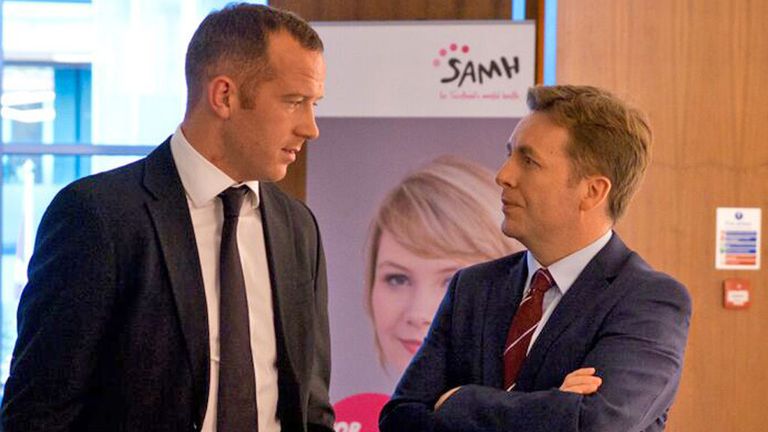
Finally, I was in awe of how Stoke's Charlie Adam spoke about the sudden death of his father, Charlie Snr (a team-mate of Paatelainen at Dundee United in the late-80s). If you haven't seen it, you can watch my extended interview with Charlie using the On Demand section of your Sky HD box. Charlie is an ambassador for Scottish mental health charity SAMH and he makes an excellent spokesman which makes him a credit to the football family.
Keep up to date on Scottish programming and stories by following @ScotlandSky on Twitter.