Fortuna for All: Dusseldorf club still growing by making games free for their fans despite their struggles on the pitch
Fortuna Dusseldorf's latest free game takes place when they host Paderborn in front of over 50,000 supporters on Sunday. Adam Bate visits the city to find out how the Fortuna for All initiative has been a success - even as the team struggles in the second tier

Friday 30 January 2026 10:23, UK
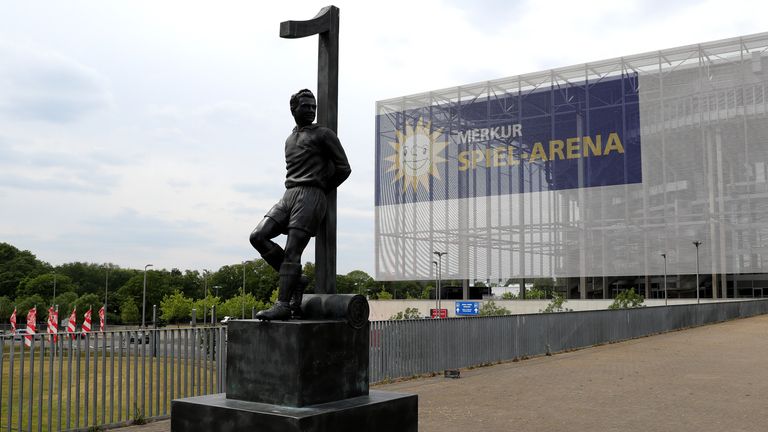
The Dusseldorf Arena is not Germany’s prettiest stadium. Its façade has a supermarket warehouse feel. Even the statue of 1954 World Cup winner Toni Turek leads to a grey hotel block attached to the ground. It is what is going on inside that is extraordinary.
Fortuna are an ordinary team, languishing just one point above the relegation zone in the second division of German football. But when they host Paderborn on Sunday, there will be 51,500 supporters in the stadium. And they will not have paid for their tickets.
For the third season in a row now, this club on the east bank of the Rhine are allowing fans into some fixtures for free. Fortuna for All started with three games in the 2023/24 season, expanding to four for the following campaign. This is the fourth of five this year.
- Got Sky? Watch Bundesliga games LIVE on your phone📱
- No Sky? Get Sky Sports or stream with no contract on NOW📺
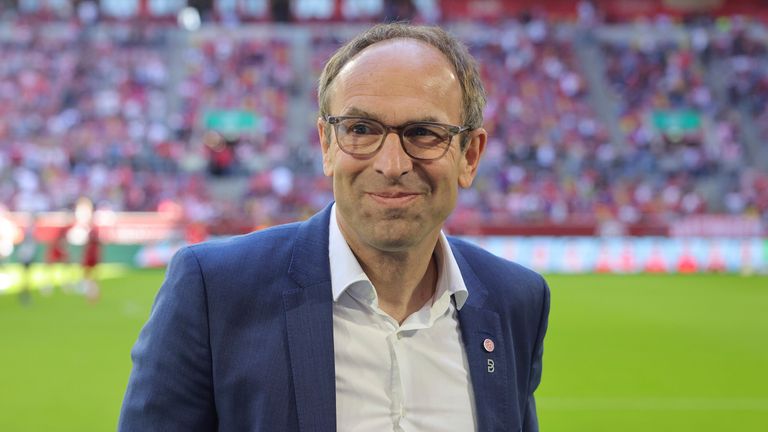
Speaking to Alexander Jobst early into the venture, the club's chairman explained that the move came from a need to think differently. "Business as usual was not an option for us. With the old business model, we realised we could not continue like this."
What is fascinating is that three years into the new model, while the team on the pitch is struggling, that leap of faith has been rewarded. Despite giving up vast sums of ticket sales, the club's overall annual turnover has grown by 35 per cent, up 20 million euros.
They have doubled their commercial partnership revenues in the last three years and tripled their merchandise revenues. Broadening the supporter base has brought rewards but so has making Fortuna a brand that others want to be associated with.
Hewlett Packard Enterprise are among the commercial partners sponsoring free games. Speaking to Johannes Koch, their managing director in central Europe, he acknowledges that Fortuna differentiating themselves made them an attractive proposition.
"That was the main reason," says Koch. "Clearly, as a global brand, you have to say, and we always have said, that probably Fortuna would not be our first target. We are also working with global brands like Barcelona. But in this case I think it was different."
In other words, Fortuna's move resonated. Perhaps they even became cool. And in a city with a population of over one million that is a major growth opportunity for the club. It has become normal now to receive over 100,000 ticket applications for the free games.
Visiting Dusseldorf recently for their victory over Arminia Bielefeld - a paid fixture - the ground is not full and poorer for it. But even a turgid game on a cold Friday in January has attracted over 39,000 fans - 10,000 more than the average prior to the campaign.
The decision-makers at Dusseldorf attribute that directly to this venture. As well as re-engaging lapsed fans, there have been approximately 40,000 first-time visitors as a result of the Fortuna for All initiative. Around a third of them have paid to come since.
"The key message is that people who come for the first time to a full stadium, they like the full atmosphere, so they are willing to come again," says Jobst. Membership is up by almost 10,000. A ground that Jobst conceded was "a little too big" might not be now.
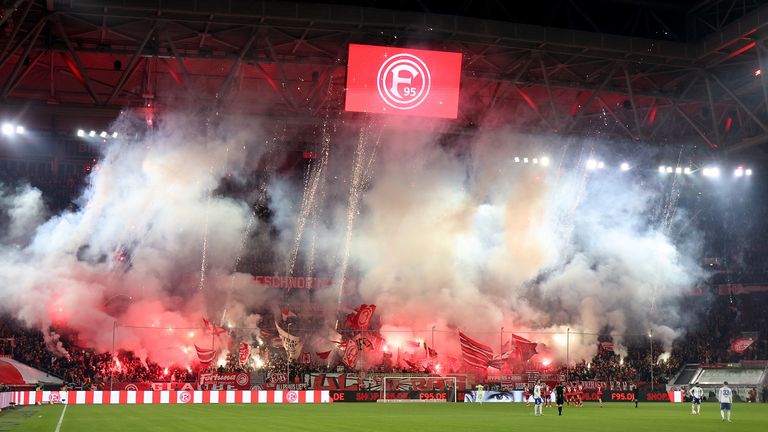
The Merkur Spiel-Arena, so named as a result of a decade-long deal for the rights with a gambling company, has tremendous acoustics with its roof and steep stands. It serves as a music venue with acts like Coldplay, Lady Gaga and Robbie Williams among its visitors.
But Fortuna are filling it now, the pattern of blue, red and yellow seats that create the colourful illusion that it is closer to capacity than it really is not quite so necessary now. All it would take is a little success and they could have full houses every single fortnight.
For now, Dusseldorf is still no football heavyweight of a city. While Borussia Dortmund and Schalke are based nearby in smaller towns and even Leverkusen boast champions, there has always been a sense that Dusseldorf has other things going for it instead.
As Jobst puts it: "If it were a sleeping giant, it would have woken up 20 years ago." But thanks to this imaginative approach, perceptions about their potential have changed at a club that were last champions of Germany in 1933. It just needed that little nudge.
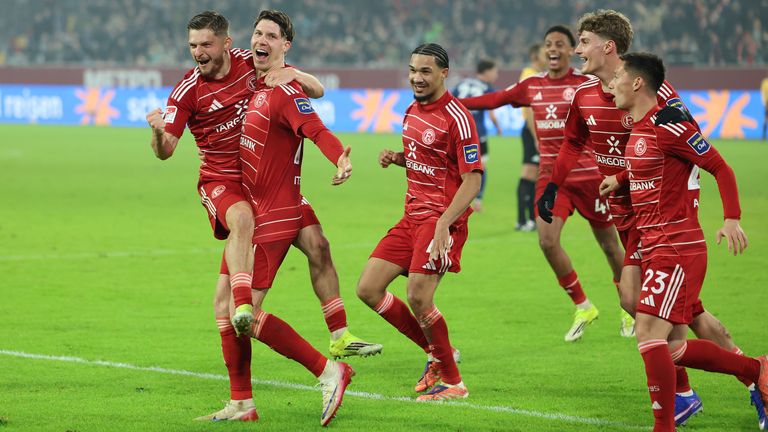
For the team, it remains a struggle. Desperately close to promotion to the Bundesliga in 2024, they lost a three-goal lead in the promotion play-off against Bochum. Last season, they faded. This season, they are vulnerable to the possibility of relegation.
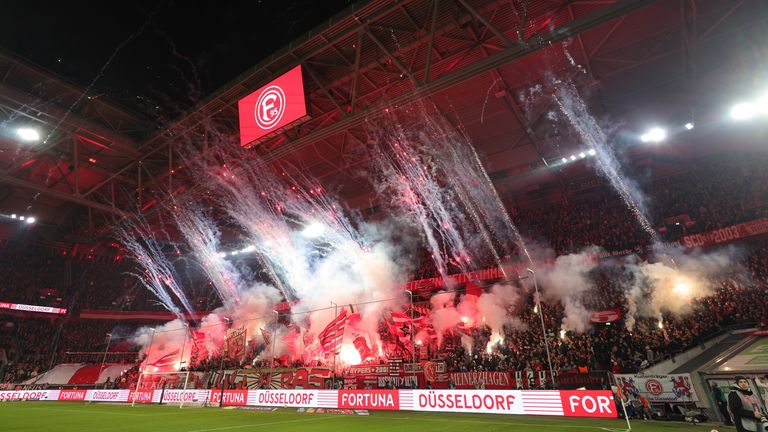
But the longer-term prospects are better and there is sense that supporters still know it. On this particular Friday at Fortuna, as the pyro rages, the ultras behind the goal hold up a banner saying that the wind will change direction - a line from the club's anthem.
So, when Florian Bunning, director of business development, talks of rethinking "the whole cultural business model around football" it is tempting to think that Fortuna have already won. Plans to extend the initiative continue. There is a dream of every game being free.
"We see now the economic way that we can go forward as a club," says Jobst. It is a future that is no longer tied to success on the field but to something much bigger than that. It is built on that beautiful idea that Fortuna, and by extension, football, is for everyone.