
Granit Xhaka: Arsenal's often-maligned midfielder will leave a void following his redemption under Mikel Arteta
Granit Xhaka is set to leave Arsenal for Bayer Leverkusen following an eventful seven-year spell at the Emirates Stadium; Switzerland international endured numerous lows but departs having rebuilt his relationship with the club's supporters under Mikel Arteta

Thursday 6 July 2023 16:56, UK
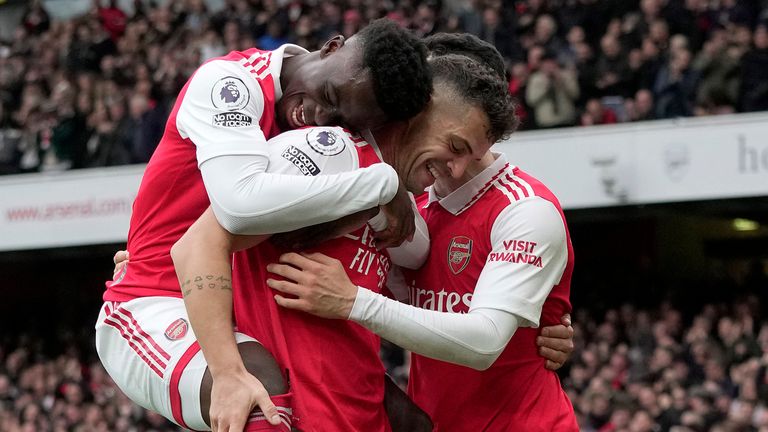
Given how he has divided opinion at Arsenal, it is probably fitting that there are contradictory sides to Granit Xhaka's departure. At 30, entering the final year of his contract, it is undoubtedly the right time. And yet it is also true that he will be missed.
Few could have predicted that a player jeered by his own fans and stripped of the captaincy three and a half years ago would one day leave on a high. It felt implausible as recently as January of last year, when he was pilloried for a red card against Liverpool.
That dismissal at Anfield, for a last-man foul on Diogo Jota, was his fifth as an Arsenal player and taken as proof that he could never truly change his ways. But, on an emotional afternoon at the Emirates Stadium for the final game of last season against Wolves, fans who previously doubted him could be heard singing his name.
"Nothing but love for you all," he said afterwards, the sense of mutual affection enhanced by a player-of-the-match performance in which he scored two goals - taking his tally for the season to seven - and generally excelled in the left-sided No 8 role that ultimately changed the course of his Arsenal career.
- Analysed: Declan Rice's 'X-factor' made him No 1 target
- What Declan Rice adds to Arsenal and where he will fit in
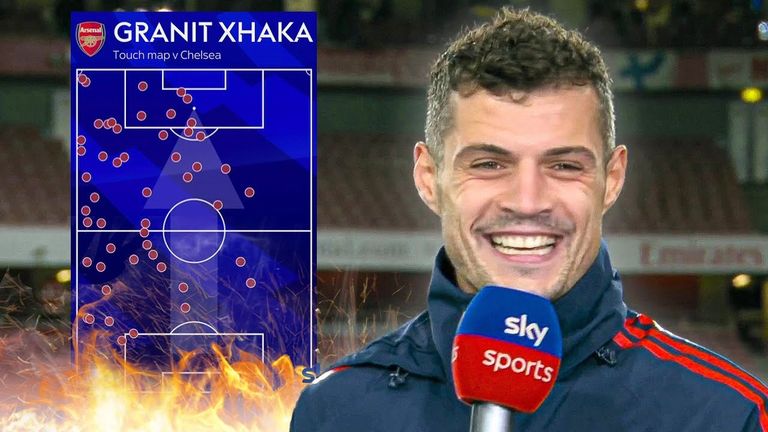
Mikel Arteta had of course put his faith in Xhaka as soon as he was appointed at the Emirates Stadium in December 2019, convincing him to turn down a mid-season move to Hertha Berlin. But it was that positional adjustment which facilitated his redemption.
For years, Xhaka had operated at the base of midfield, where, lacking the speed or physicality of a player such as Thomas Partey, who subsequently replaced him there, or West Ham's Declan Rice, who may be next to take on the role, he often found himself vulnerable to opposition runners, his weaknesses exposed.
Arteta, seeking a solution to the issue, and a different way of harnessing the qualities he offers in possession, first trialled pushing him into a more advanced role in the second half of the 2021/22 season.
"Sometimes, you have to take players out of their comfort zone and open a different door to explore how the team will react to it, and what the opposition will do," he explained at the time.
The Swiss international looked an unnatural fit for the position initially but, by the end of the campaign, Arteta had seen enough to convince him Xhaka could flourish there and so it proved.
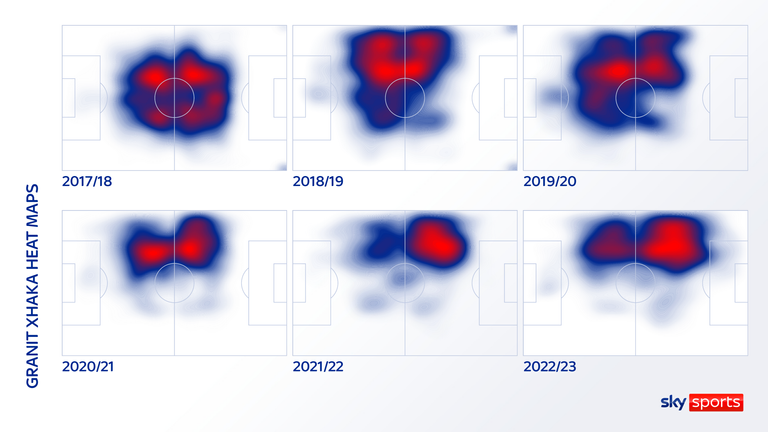
During a campaign in which Arsenal challenged for the title, outperforming even the most optimistic of pre-season expectations, Xhaka started all but two games, providing a combined total of 14 goals and assists, and adding a new dimension to the team's attack.
It is a testament to Arteta's coaching ability that he was able to coax such a transformation from a player approaching his 30s. But it also speaks to the professionalism and adaptability of Xhaka himself. "He is willing to change things, to improve constantly," said Arteta.
The Spaniard is not the first Arsenal manager to value him highly.
Arsene Wenger, the man who brought him to Arsenal from Borussia Monchengladbach in the first place, used him more than any other outfield player in his final two seasons as manager. Unai Emery, meanwhile, made him captain, albeit only fleetingly.
"The fact that Arsenal managers continually pick him and he goes straight into the team when he's fit shows that he's a good character and player," said Sky Sports pundit Jamie Carragher.
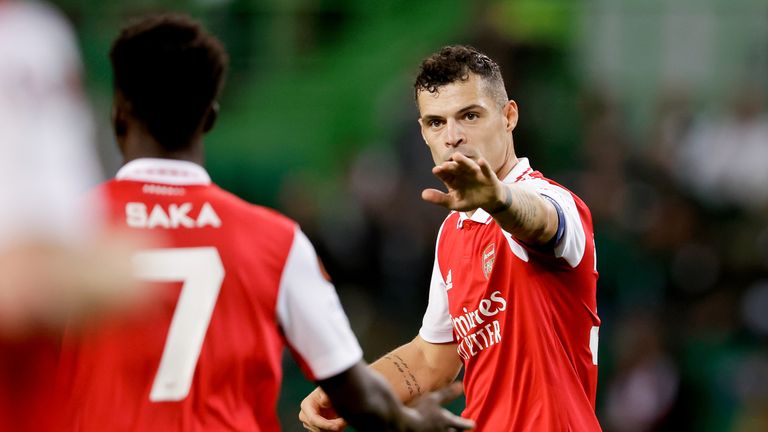
Indeed, since his debut, in August 2016, only four outfield players - Harry Kane, Wilfried Zaha, Cesar Azpilicueta and James Ward-Prowse - have played more Premier League minutes than Xhaka.
His longevity is such that he leaves Arsenal having made more Premier League appearances for the club than Cesc Fabregas or Freddie Ljungberg and, while nobody could argue he should share the legendary status of that duo, there is no disputing his importance as a leader.
Wenger was raving about those leadership qualities within weeks of his arrival at the club in 2016 and they have only become more pronounced as Arteta has lowered the age profile of his squad.
"We have a very young team,' said Xhaka on the All or Nothing documentary last season. "Our job, as experienced players, is to give them a lot of advice and to tell them it is not so easy, because you need a lot of work."
He has been key in helping Arteta maintain standards, showing a willingness to chastise as well as encourage, as he did in the wake of Arsenal's costly loss to Newcastle last season. "It doesn't matter the age," he said. "If someone is not ready for this game, stay at home."

Those comments were deemed harsh by many at the time, but look at how his young team-mates responded this season, their progress summed up by the steely 2-0 win over Newcastle in May at the scene of that painful defeat a year earlier.
"For young players like me and Bukayo [Saka], it's very important to have a team-mate like him," said Gabriel Martinelli of Xhaka. "You see how much he dedicates himself to the team, how much he cares… He is definitely one of our leaders."
His importance as a character could be seen on the pitch as well as off it and, although there is room for an upgrade in his position, Arteta will be aware of what Arsenal lose when he is not present.
Consider the fact that they only won one of their last four Premier League games without him - and even that solitary victory, against Bournemouth in March, was achieved in desperate, last-ditch circumstances.
More recently than that, there was the chaotic 3-3 draw with Southampton, another game in which Arsenal were crying out for Xhaka's experience and steadying influence in midfield.
Some may scoff at the notion that Arsenal have come to rely on the calming presence of a player who has previously demonstrated such a maddening propensity for rashness and ill-discipline.
But his managers will tell you there has always been more to Xhaka than first meets the eye, and his redemption over the last 18 months has allowed him to finally show it. He exits on a high, leaving behind a void, both on and off the pitch, that will need to be filled.