Exclusive
Inside Sant Andreu: Barcelona's anti-fascist cult club capturing the imagination and set for promotion to Spain's third tier
UE Sant Andreu are on the brink of promotion to Spain's third tier and are now a cult club due to their anti-fascist principles. Adam Bate pays a visit to find out what makes them different and hear about their dream of reaching the second division for the first time since 1977

Friday 10 April 2026 08:17, UK
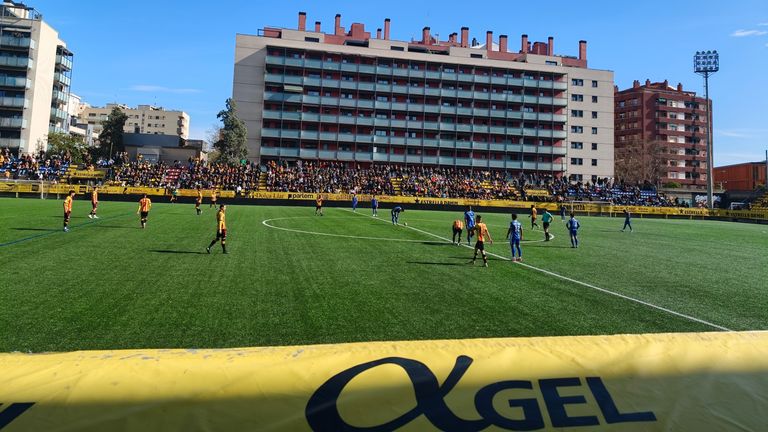
“Sant Andreu is a way of life,” says Roger Graells Font, director of communications at the club. A visit to this Catalonian outfit playing in Spain’s fourth tier is proof of that. Sant Andreu have become a cult club. They are unique and they are on the rise.
Finding a following in the city of Barcelona, home to one of the world's most successful clubs, is not easy. Any Espanyol supporter will tell you that. But Sant Andreu are growing because they represent their community and they stand for something different.
The club is proudly anti-fascist and anti-racist, a policy that has been driven by the supporters. It has earned them admirers beyond Sant Andreu but it is more than just something to put on the stickers and for the street sellers to flog to the tourists.
- Got Sky? Watch Premier League games LIVE on your phone📱
- No Sky? Get Sky Sports or stream with no contract on NOW📺
- Choose the Sky Sports push notifications you want! 🔔
In 2024, the ultras displayed a tifo celebrating three women who were symbols of the revolutionary cause during the Spanish Civil War, including Elisa Garcia Saez. She was one of Sant Andreu's own, born there only to die fighting fascist nationalists in 1936.
Since then, the club has allied itself with campaigns supporting refugees in the region and encouraging the elderly to engage with both football and the wider neighbourhood. "Being part of Sant Andreu implies a commitment that goes beyond football," says Font.
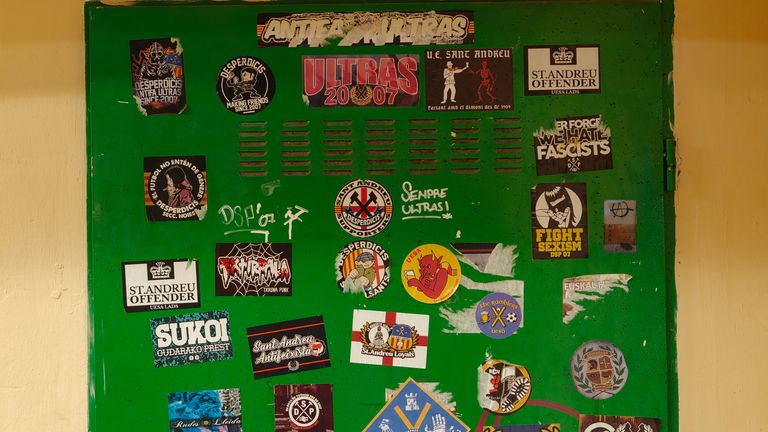
"It is a commitment to the community and to a set of values that are intrinsic to the club." As well as overtly opposing fascism and racism, Font mentions "Catalanism, the defence of human rights and women rights" as other core values that have come to define the club.
"These are causes that we actively promote and we proudly stand for. We are a club with a very strong identity of our own, proud of our working-class past and committed to defending just causes. You do not find all of this in professional LaLiga clubs."
It might explain why Sant Andreu is growing. Their membership numbers tripled to 3,500 when promoted to their current division in 2023 but that figure will increase further next season because the team is on the brink of going up to Spain's third tier.
Seventeen unbeaten and on a run of nine consecutive wins, Sant Andreu go into the weekend nine points clear of the team in second with just four games remaining. Beat Valencia Mestalla for a record-equalling 10th win in a row on Sunday and promotion will be theirs.
It is a talented group of players. Long-serving captain Albertito dominates the midfield. Alexis Garcia, a 28-year-old winger in his second spell with the club, offers deft touches out wide. Veteran forward Marcos Mendes has a habit of adding goals from the bench.
"There is a very close relationship between the fans and the players," says Font. He is talking about an emotional connection but among the first things that any visitor to the Narcis Sala stadium will notice is that this closeness is also a literal truth in Sant Andreu.
Few stadiums are nestled so snugly within the community that the balconies of the surrounding tower blocks - many of which have the Catalan flag draped from them - look out onto the pitch. Every once in a while the football will find them when booted skywards.
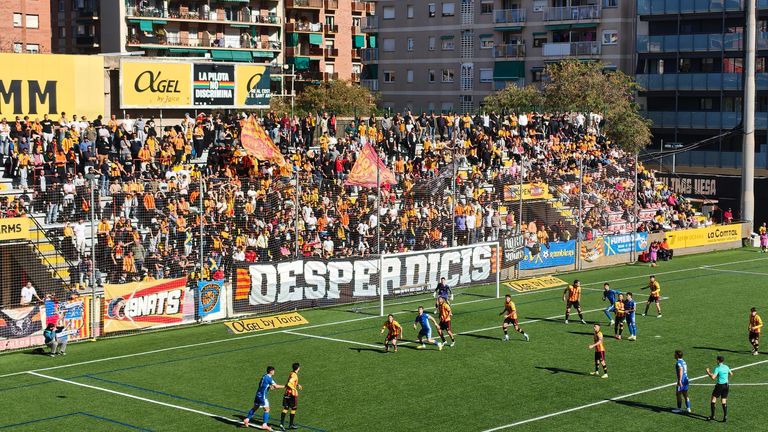
The artificial pitch comes complete with blue lines marking out the futsal boundaries. Even the assistant referee has to dodge the mini-goals that are still there behind him during play. Small time, some might say, but it does not stop the ultras from bringing the noise.
"The Narcis Sala has a warmth that is truly special and unlike what you see in most stadiums in Catalonia and Spanish football." An entire community hums with activity on matchday, bars packed, flags waving. In truth, it does not feel like Barcelona at all.
Sant Andreu regards itself as separate. Its residents will routinely talk of 'going to Barcelona' when they make the trip to the city centre. The club's motto, 'L'Orgull de Poble' - the Pride of the Town - is an explicit expression that this is very much its own place.
"Sant Andreu de Palomar was an independent town until its annexation by the city of Barcelona in 1897," points out Font. "That village spirit, with its distinct identity, has endured to this day. Our club continues to remain faithful to this unique identity."
Next season, they will get to share that identity more widely, spreading their message to a bigger audience. "That is virtually a professional division." But the bigger goal is not just returning to the third tier for the first time in over a decade but taking the next step.
Sant Andreu have not played in Spain's second tier since 1977. "Promotion would be an important step towards the dream. The medium-term goal is to reach the Segunda Division of LaLiga." This rise will require an overhaul to match the achievement.
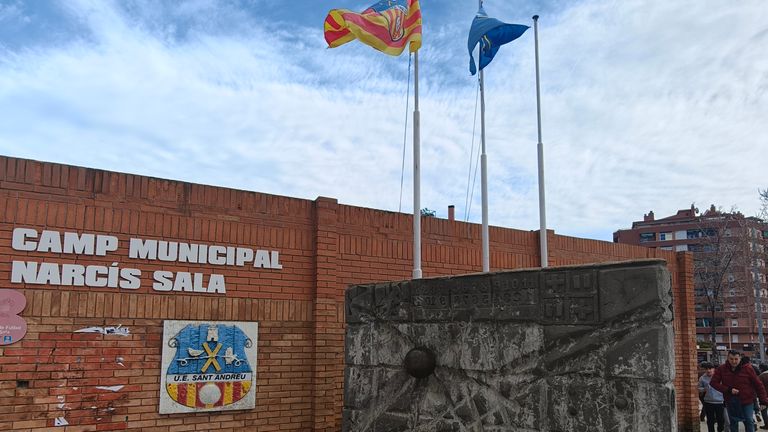
"As you move up the divisions, the stadium and facilities must be adapted to meet professional football requirements." In other words, those five-a-side goals, the plethora of pitch markings on the artificial turf, all of it would have to go next season.
"Promotion would require installing natural grass at the Narcis Sala," acknowledges Font. "The stadium is municipally owned, it is the property of the Barcelona city council, so the involvement of the council would be necessary to make this possible."
But there is excitement at Sant Andreu, that sense of purpose, the feeling of a club that is on a journey and is abuzz with all that this brings. As ever with such transformations, there is a little unease about the inevitable adjustments that accompany this progress.
They are getting used to the curious tourists, the groundhoppers. Everyone just wants to keep what makes Sant Andreu different. "Reaching the Segunda Division must not mean losing the essence that makes us so special and of which we are so proud."
They are not there yet but, with promotion looming, the parties are being planned. That goal of reaching Spain's second tier is getting a little closer too. They do not see themselves as from Barcelona. But the city has another club worth watching in Sant Andreu.