
Analysis
Championship play-offs to change - but will it be good change for the second tier?
Sky Sports EFL Editor Simeon Gholam takes a look at the changes to the Championship play-off format, which sees it expand from four teams to six from next season after an EFL vote was passed on Thursday.

Friday 6 March 2026 11:20, UK
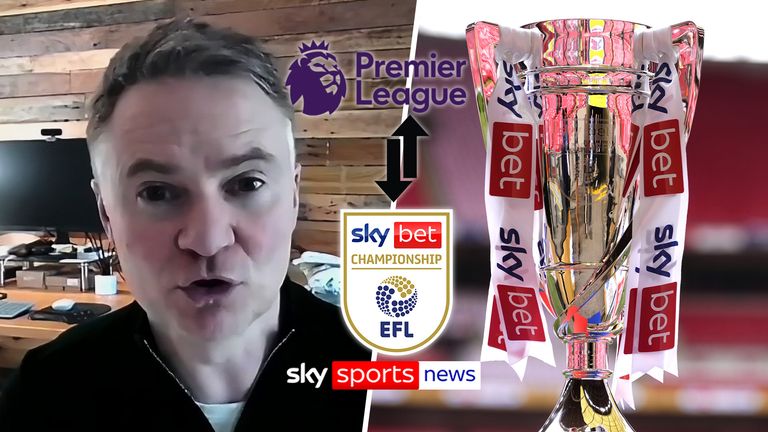
EFL clubs have voted to extend the Championship play-offs from four teams to six from next season.
The decision was passed by a majority of EFL and Championship clubs, and represents the first change to the second-tier play-off format since 1990 - when the final was switched to Wembley for a one-off tie, having previously been a two-legged affair.
England's second tier has adopted a similar model to the one in the National League, with eliminator matches included before the semi-final stage.
What will (and won't) change?
While the format will not be confirmed until the summer, it is expected that the expansion would see the play-offs take a similar shape to the current National League format, albeit with a couple of key differences:
- 1st and 2nd are automatically promoted as normal.
- 3rd and 4th qualify for the semi-finals.
- 5th vs 8th, and 6th vs 7th in one-off eliminator ties at the home of the side who finishes higher up the league.
- The winners of the eliminator ties progress to the semi-finals, to face 3rd and 4th in the format that currently exists - two-legged ties with the second leg at the home of the side that finishes higher up the league.
- One other key thing to note is that, whatever, happens, 3rd will face the lowest ranked team remaining in the semi-finals. So if 8th beats 5th, and 6th beats 7th in the eliminators, 3rd will face 8th and 4th will face 6th. There is no pre-set path for the semi-finals before the eliminators.
- As per usual, the winners of the two semi-finals meet at Wembley for a place in the Premier League.
But will the new format be a good thing?
Sky Sports EFL Editor Simeon Gholam has covered every play-off campaign since 2016/17, and he takes a look at some of the key questions about the new plans...
- Got Sky? Watch your EFL team on the Sky Sports app
- Not got Sky? Stream your EFL team with no contract
- Get more EFL to your phone with WhatsApp
Would the eighth-placed side reaching the Premier League dilute the quality and would they even have a chance to compete?
The big question. A lot of concerns have been aired over the prospect of a team finishing eighth in the Championship going on to reach the Premier League, and not being able to compete.
Frankly, for several reasons, that might be a non-issue.
First of all, it is rare enough for a team finishing sixth to actually win the play-offs in the current format, let alone a side finishing eighth and then having to face an extra eliminator before getting to the semi-finals - should that be the format.
There have only been two occasions in the Championship era (since 2004/05) when a team finishing sixth have gone on to win the play-offs. West Ham did it in 2005, and Blackpool were the last 16 years ago.

There have also only been five occasions in total in the same stretch of time when the team finishing sixth have even reached the final.
The difference in quality and points between the sides finishing third and sixth is usually a lot wider than between the sides finishing sixth and eighth.
For example, last season, Sheffield United finished 22 points ahead of Bristol City. There were fewer points between Bristol City and the relegation zone. And that chasm showed in the play-off semi-finals as the Blades cruised to a 6-0 aggregate win.
The average gap between third and sixth since 2004/05 is just over 10 points. In the last 10 years the average has risen to 12 points.
In the Championship era the average gap between sixth and eighth, meanwhile, is just 4.6 points.
Last season the gap between Bristol City in sixth and Millwall in eighth was just two points. Middlesbrough could have made the play-offs with a win on the final day and ended up finishing in 10th.
The difference in quality between any of those sides heading into the semi-finals, would have been minimal. Frankly, there is not much more of a concern between a side finishing sixth or eighth being promoted, based on league placing alone.
Will it offer any advantages to clubs in the Championship?

Yes. For one, it offers a serious competitive advantage to finishing third or fourth, beyond just a home game in the second leg of the semi-finals.
Last season, Sunderland found themselves in a position where they barely had to turn up for the final couple of months of their season because they knew they couldn't realistically finish in the top two, or outside of the top six.
Had they faced the potential of a drop from fourth to fifth leaving them with an eliminator tie, they might not have turned off and lost their final five games of the season. The prospect of avoiding an extra eliminator tie is genuine incentive and a real difference maker.
It will also provide genuine hope for clubs with smaller budgets to believe they can give themselves a chance, while fallen Premier League sides will also be keen as it provides a little bit more of a safety net.
Sure, finish seventh or eighth and you will still face an arduous road to get to the Premier League. But the opportunity is there. Getting to eighth is obviously a more realistic goal for most than getting to sixth.

Will it reduce the number of teams with nothing to play for towards the end of the season?
Not really. The thought process that it would lead to fewer games with nothing at stake is also largely flawed.
Last season going into the final day we had an undecided title, two play-off spots still up for grabs and two teams from five that could have been relegated.
In my near-decade of covering the Championship for Sky we have never had a final day with nothing to play for.
Invariably, we have at least a couple of promotions, play-offs and relegations still to determine. There is always excitement. This expansion will do very little to change that.
The National League structure is deemed unfair by some, so why bring it to the EFL?

As mentioned, the proposed system is similar to the one in the National League, which some consider an unfair one.
Last season, for example, sixth-placed Oldham Athletic finished 23 points behind second-placed York City. The Latics won their eliminator and then beat York 3-0 away from home in the semi-final, before sealing promotion in the final at Wembley when they beat Southend.
It should be noted, however, that the semi-finals of the Championship format would remain two-legged. And the top two still qualify automatically, whereas in the National League second place goes to the play-offs.
But still, it does on paper offer a similar playing field to sides that have been worse over the course of a long season.
Is another game before the semi-finals really necessary?
A fair question in an already jam-packed season where players, clubs and fans are all already stretched to the limit.
But, as spectacles, the eliminator ties will be brilliant. In themselves they would be mini play-off finals. They would provide jeopardy and undiluted drama, and would be a fascinating watch.
I've also always felt there is slightly too big a gap between the semi-finals and the play-off final. An extra game within a similar window of time would prevent any momentum being lost.
Conclusion: The positives just about outweigh the negatives...
The format change is not without its flaws, and I don't really like the impact it would have on telling the story of the race for the play-offs throughout the season.
There is concern that the number of teams that could be involved in the race for the top eight might make genuine discussion more difficult.
But for me, the tweaks just about see the positives outweigh the negatives.
While there remains the possibility that a team finishing eighth could reach the Premier League, it wouldn't be a huge difference to a team finishing sixth doing the same.
And, as shown above, it is rare enough for a team finishing sixth to make it. Just two in two decades. The odds on an eighth-placed side managing it must be longer still.
What happens next?
While the format above is expected to be the one adopted for the 2026/27 season, the precise system will be voted on at a later stage - possibly at the league's annual general meeting in the summer.