Ahead of his return on Wednesday, Alex Dunn looks back at Diego Maradona's last visit to Hampden in 1979.
Watch Maradona's return as Scotland play Argentina, live on Sky Sports 1
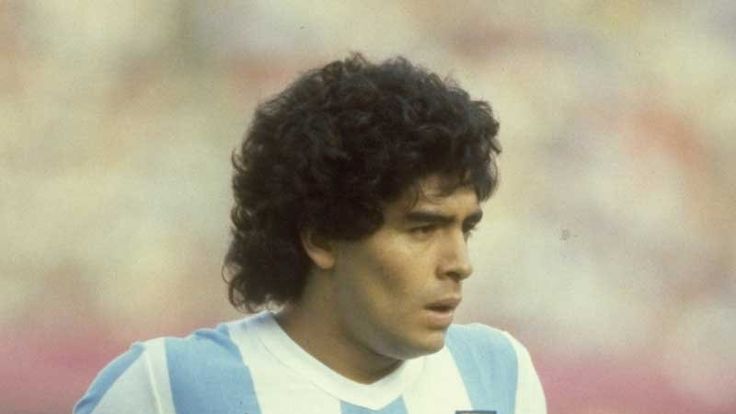
The 2nd June 1979 was a sweltering day in Glasgow. The hottest in the city for 30 years. And none more so than for the Scotland side that spent much of it chasing Diego Maradona's effervescent shadow.
A year earlier Argentina had claimed football's greatest prize in their homeland, as the ticker-tape reception they received in the final against Holland - played in the Estadio Monumental, Buenos Aires - became one of the Beautiful Game's most enduring and iconic images.
It was tartan rather than ticker-tape that greeted the world champions at Hampden Park though, as the svelte Mario Kempes, a Golden Boot winner in '78, became the prey of young Scottish autograph hunters. By full-time Mario may well have been Luigi, as the name on the lips of the 61,918 present in the stands and 11 knackered, frustrated but ultimately awestruck Scottish players was Diego.
Diego Maradona.
And on Wednesday he's back in Glasgow. Back at Hampden. Back from a journey that could fill a thousand lives. A story born in the shanty town of Villa Fiorito; which has seen him peer over the precipice of death and come back, win the World Cup, be kicked out of the World Cup, overcome a cocaine addiction, swap cigars and anecdotes with Fidel Castro and Hugo Chavez, brush shoulders with the mafioso in Napoli and borrow God's hand in 1986.
Thankfully for Scotland's players, Maradona's impact on the game will be restricted to the dugout, as he attempts to prove wrong the old adage great players don't make great coaches. Patrolling the opposite technical area will be George Burley - who played in the 1979 game - and Terry Butcher, a man-child still holding a 22-year grudge that will not, he claims, allow him to shake the hand that knocked England out of the 1986 World Cup. Maybe he'll just kiss the foot that scored football's finest ever goal in the same game.
Burley and team-mates were well aware of the capabilities of an Argentine side that housed Kempes, Daniel Passarella and Osvaldo Ardiles, but the name of Maradona was cause for intrigue not consternation. Maradona was always in contention for Argentina's 1978 World Cup squad having made his international debut as a slight but strong and precociously gifted 16-year-old; but he failed to make the cut when coach Cesar Luis Menotti trimmed his provisional selection from 40 to a final 22.
He would need just 90 minutes in Glasgow to score his first international goal, prove a point to Menotti and bewitch a Scottish nation.
Genius
"It sticks in my memory as one of the best experiences of my career," recounts Burley.
"I can still picture Maradona running quicker with the ball at his feet than he did without it. His ability to wriggle past people was fantastic."
Squat and punchy with a mesmerising centre of gravity, Maradona beguiled his opponents as Alan Hansen recalls a strength that belied his size. Still in the infancy of a career that would encompass four World Cups, Maradona had done enough to convince the European Cup winner of his potential.
"When we played against him, Argentina were the reigning world champions from the previous summer and had people like Mario Kempes and Leopoldo Luque playing for them, the big stars of that World Cup.
"Maradona was actually 10 times better than them."
Playing alongside Hansen that day was Paul Hegarty and the former Dundee United skipper was similarly at a loss to find superlatives that did the 18-year-old justice.
"They also had this 18-year-old wonderkid and it was the first time Europe had seen Maradona. Straight away, you knew he'd very soon be mentioned in the same breath as Pele, Franz Beckenbauer and Johan Cruyff," said Hegarty.
"Their movement and pace were exceptional - and Maradona was just head and shoulders above everyone else.
"I think there were a couple of occasions when I almost got near him. But he was just something else.
"Perhaps the most frightening thing was he was still seven years from his brilliant peak.
"He was strong and had great quality. He also had great balance and it was so hard to get the ball off him."
First goal
The game ended in a 3-1 victory for Argentina as Maradona scored the third goal, after fooling Scotland goalkeeper George Wood with a trademark dummy: "I honesty didn't realise that it was his first-ever goal for Argentina until I read his book. He got the ball in our box and sold me a dummy. I was frustrated because I bought it and it went in."
It is testimony to the man's genius that a career dripped in controversy, feathered and tarred in scandal, has been allowed to come full circle. Redemption and respect will be intertwined on Wednesday evening, as Maradona leads Argentina for the first time since he dothed an international cap for the final time against Nigeria at the 1994 World Cup. The wild eyes that saw him sent home from that competition disgraced are, for the moment at least, retired.
Glasgow on 19th November 2008 will not be as hot as it was back in June 1979 but the memories Maradona has left behind from his playing days (one in particular springs to mind) will ensure the Scots afford him an even warmer reception on the coolest of evenings.