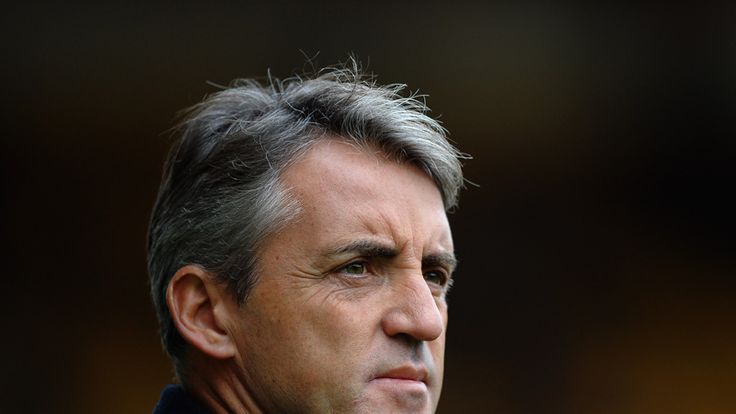
Does temper and talent make Roberto Mancini the right man for Manchester City? Kait Borsay investigates
Their defeat to Wolves was their second successive league defeat, and worse still, Manchester City have now suffered a poorer start to the season than under Mark Hughes last year. The rumoured rumblings of disquiet amongst players make this a tricky time for manager Roberto Mancini. Exceptionally talented or flawed masterpiece? Kait Borsay looks at the man in charge of the City superstars.
On the Italian television show
Le lene guests were asked to describe themselves in one adjective. Roberto Mancini chose 'Genius'. A comment made in jest or a true reflection of the ego and impalpable belief that the Manchester City boss has in his methods and ability? If only the City faithful could honestly say they feel the same.
Few can call into question Mancini's playing career. A footballing prodigy, he made his Serie A debut for Bologna aged 16. A year later he joined Sampdoria where for eight years he formed a formidable partnership with Gianluca Vialli, winning the league in 1991, the Cup Winners' Cup in 1990 and reaching the European Cup final at Wembley against Johan Cruyff's Barcelona in 1992.
Mancini remained at Sampdoria for 15 seasons, playing as a deep-lying striker in the Teddy Sheringham mould, then in 1997 joined Sven Goran Eriksson at Lazio, where he won another Serie A title. In his final season with Lazio he became Eriksson's assistant and when his mentor took the England job, Mancini came too, albeit to Leicester City, where he hoped to learn more about the English game. His career in England was short-lived though and he left the Foxes after a month.
The departure was triggered by a return to Italy and the chance to manage Fiorentina. So keen were the Italian football authorities that Mancini begin his management career they granted him special dispensation to coach without the necessary badges. Victory in the Italian Cup followed a few months later and Mancini moved from one cash-strapped club to another the following year by heading back to Lazio, where he won another Italian Cup.
His success earnt him a move to Inter Milan, and there followed three league titles and two more Italian Cups. While the history books will record he was Inter's most successful manager in three decades, it could be argued his results were distorted by the Calciopoli scandal. As Juventus fans like to point out "his first title was handed to him by a tribunal, his second came when Juventus were in Serie B and Milan had a points penalty, and he had to come from behind on the last day of the season to win his third."
Champions League success eluded Mancini at Inter and he resigned in February 2008 on the back of their exit at the hands of Liverpool. Although he retracted his decision the following day, his relationship with the Italian media and the club's bosses was already on a downward slide and he was eventually sacked just a few months later. After a period of forced abstinence, he joined Manchester City in December 2009.
So what of the man behind the career? David Platt, his ex-Sampdoria teammate and his current first-team coach at City remembers him as a regular guy through the week who became fiendishly driven and unrecognisable on match days.
"I'd wonder what I had done to upset him" Platt said. "He was just in another place. And brutal at half-time if things were not going right - the most vocal member of the dressing room."
As a player Mancini preferred being a big fish in a small pond.
"I could have gone to Juventus, to AC Milan, to Inter Milan, many times, but I preferred to remain because Sampdoria were my family, from the owners to the players. I wanted to be a big player - but big with my team, not big because my new club was big."
Is it his ego that makes him a natural leader, with a 'my way or the highway' mentality? Platt remembers his significance at Sampdoria.
"Even when he was playing - at 25 or 26 - he was doing all the jobs at Sampdoria, coaching, speaking to the president, looking at the transfers."
Or does it get in the way? Is he too big for his boots? An unwillingness to change his methods; to listen. Mancini has always maintained that the most important quality a manager needs to be successful is luck. When asked in 2003 "Who's your master?" His one-word answer was "Eriksson." He credits the Swede for teaching him how to pause and how to think.
We know the Italian is not afraid to make enemies. He called time on his international playing career after the then Azzuri coach, Arrigo Saachi refused to bow to the striker's demands, by not guaranteeing him a place in his squad for the 1994 World Cup finals. Relations were always strained between Mancini and Fabio Capello. When the latter was managing the Juventus team that were then relegated to Serie B because of the Italian match fixing scandal, Mancini was quick to dig the knife in. In return Capello mocked Mancini's by-proxy title win. And I haven't even started with those who have fallen foul of him at Manchester City.
Questioned
Carlos Tevez, the City captain, along will the now loaned out Craig Bellamy both questioned Mancini's training regime last season, criticising the number of double training sessions and extra work they had to do. Highly paid players berating their manager for having to put in an extra shift at work is hardly going to win over most of the paying public although City's injury record did get significantly worse when Mancini took over, which did affect the players available for selection.
Mancini maintains that he always knew he was going to be taken to task over his training methods.
"If you spend your week playing at three o'clock and eight o'clock it is not right to work only in the morning. Your body is not ready for it." Mancini has said. "With football you live very well. Not just you, but your family and sometimes everyone you know; so you must be one hundred per cent ready.
"There are players whose only target is their day off. You must replace them with those whose target is the win against Chelsea, then against Arsenal, then against Manchester United, who will work every day for this. Yes, there is still the day off, but you must never loose your focus even then"
So you can imagine the wrath that was felt by Gareth Barry, Jo Hart, Adam Johnson and Shay Given when they decided to take a trip up to St Andrews to enjoy not only the golf, but the revelry of a student party taking place in the Scottish city.Mancini is quick to preach to a squad that he feels is "maybe fifty or seventy-five per cent there".
"Right now, some players, they come, warm up, play the match and then (are) gone. They need to learn from those who treat even the training days like it is a match; they are here one hour early, they are thinking of the job all the time and when they finish they stay for massage to be ready for the next day and then just go home, relax and start thinking again."
This is all very well, but what about what the players? The lack of a leader on the pitch; the squabblings: you could write a whole book on all the reported episodes but to summarise: Adebayor falling out with the manager twice after being dropped from the side, grumblings from Shay Given, Carlos Tevez pre-empting one Mancini's half-time team talks, James Milner and Yaya Toure having it out at half-time at Arsenal last month, Adebayor again, this time his on the field row with Vincent Kompany against Wolves at the weekend.
We know Mancini is no shrinking violet but as well as those players listed above he's got to deal with others whose temperament has previous: Nigel de Jong, Patrick Viera... and the list goes on. The dressing room at Eastlands remains a hotbed of incendiary egos, ready to explode at any time.
The complexities of keeping a group of Champions League players happy with Europa League football was always going to be a challenge. Can Mancini really command the respect of players who arguably just need to go through the motions and show up on the day. What motivation does a group of players all earning anything from fifty to over two hundred thousand pounds a week have?
Time after time the unrest at Manchester City has been attributed to the player's desire to win.
"He gets angry if he thinks people around him don't feel the same about winning." said Yaya Toure's agent Dimitri Seluk after the defender's half-time argument with Milner at Arsenal. "He has such a winning mentality that he will fight with anyone, player, fan or staff, who does not share this."
How does this translate then, with the fact he drove home - albeit with permission - during the second half of the Arsenal game after withdrawing through injury. Hardly supportive.
If it is about the winning mentality I just wish they'd translate this desire as a group of players, a team, not just a set of international superstars. Platt recognised a winner in Mancini.
"The one thing that came over, even when he was a player, was how much of a winner he was," he said. "If you had those similar traits, that desire to win, you were always going to get on with Roberto Mancini."
Can all the unrest surrounding the players be excused by their desire to win or is it just their way of sucking up to the boss? You'll be forgiven the odd bust up, if you just say you want to win.
Mancini is a man who is not afraid to deal with a footballing ego or two; he is able to judge against his own standards on the self-esteem meter. Managing the talented but frustrating Zlatan Ibrahimovic at Inter Milan, putting Craig Bellamy and Robinho in their place, bringing the notoriously complicated Balotelli over to play in the Premier League - it all illustrates Mancini's confidence in his own ability.
"When people ask why I come here I tell them it is because Manchester City never win," Mancini has said. "When you work for Real Madrid or Barcelona it is easy; all managers win at those clubs. But if you build a squad, work very hard for months and years at Manchester City and then you win, for me that is more important. That would be fantastic."
Just how many months or years Mancini has at Eastlands remains a topic for popular debate.