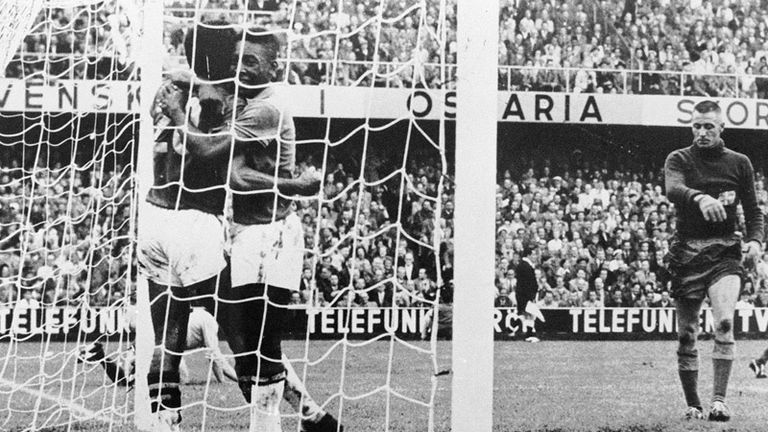
A Pele-inspired Brazil lifted the 1958 World Cup in Sweden. A star was born in the colour of yellow.
Teenager Pele inspires Brazil to first World Cup triumph
A Pele-inspired Brazil lifted the 1958 World Cup in Sweden. A star was born in the colour of yellow.
It was a tournament also remembered for its excellent home support, France's Just Fontaine and all the Home Nations being involved for the first time - and all of this received international television coverage.
The 16 sides that qualified were divided amongst four groups, this time each nation played each other without extra-time scheduled if the game ended in a draw.
Northern Ireland were drawn in Group 1 alongside Argentina, holders West Germany and Czechoslovakia.
The Northern Irish got their campaign off to a winning start as they edged out Czechoslovakia while West Germany were also victors, defeating Argentina 3-1 thanks to a brace from Helmut Rahn.
The Germans drew their second game with the Czechs, while Northern Ireland were undone by Argentina.
The Germans were held to another 2-2 stalemate, this time against Northern Ireland, while Czechoslovakia thumped Argentina 6-1, meaning West Germany finished top and a play-off match would be played to determine the runners-up.
Northern Ireland met Czechoslovakia in Malmo and fell a goal down on 19 minutes. However, they recovered valiantly via a brace from Peter McParland to book their place in the quarter-finals.
Scotland were placed alongside some fierce opposition in Group 2; with France, Paraguay and Yugoslavia all vying to progress.
The Scots earned a point in their first clash as Jimmy Murray netted in a 1-1 draw with Yugoslavia.
France, meanwhile, tonked Paraguay 7-3, with Fontaine - who only started due to an injury to Rene Bliard - netting a hat-trick for Les Bleus.
Scotland then suffered a 3-2 defeat to Paraguay while Yugoslavia triumphed against France by the same scoreline.
The Scots' campaign came to an end against France after they lost 2-1, meaning the latter topped Group 2 while Yugoslavia grabbed second spot following a 3-3 draw with Paraguay.
Hosts Sweden competed with Wales, Hungary and Mexico in Group 3, and they began well by beating the Mexicans 3-0 in their first match.
Hungary, not the force they were at the previous tournament, played out a 1-1 stalemate with the Welsh, who also drew their second game versus Mexico.
The Swedes then edged out Hungary before being held by Wales, in what was the Dragons' third straight draw.
Hungary eased to a 4-0 success against Mexico meaning they would meet Wales in a play-off encounter two days later.
Wales went a goal down versus the Hungarians when Lajos Tichy struck. However, a second-half revival ensued as Ivor Allchurch and Terry Medwin both scored to send Wales jubilantly into the last eight.
Toughest
Group 4 was arguably the toughest of them all with Brazil, Soviet Union, Austria and England all in action.
Brazil began brightly with a 3-0 win against Austria but England had to rely on a late Tom Finney penalty to salvage a point from their clash with Soviet Union, who were competing at the World Cup for the first time.
Soviet Union then downed Austria 2-0 while Brazil and England played out the first goalless draw in World Cup history.
The Three Lions battled for a 2-2 stalemate with Austria while Brazil introduced 17-year-old Pele for the first time to help them finish top of the standings with a 2-0 success against Soviet Union.
With England and Soviet Union both level on points, a play-off fixture was played in Gothenburg. And it was the latter that triumphed at the former's expense courtesy of Anatoli Ilin's 68th minute strike.
Wales were drawn against Vincente Feola's Brazil in the last eight. The South Americans appeared to be really finding their form with their 4-2-4 system proving dangerous, while their extensive preparations for the tournament, which included having their own psychologist, also seemed to be paying dividends.
The Welsh battled against the Brazilians but were ultimately outdone by striker Pele, whose 66th minute goal was the only of the game.
Northern Ireland met France in their last-eight test and exited after a 4-0 loss, with the prolific Fontaine netting a brace.
Elsewhere, West Germany edged out Yugoslavia while hosts Sweden overcame Soviet Union.
Brazil then took on France in what turned out to be the game of the tournament. The scoreline ended 5-2 in favour of the Brazilians as Pele scored three goals to book his nation's place in the final.
In the other last-four encounter, the brilliant home support, that would religiously wave flags while cheerleaders also looked to inspire their troops, willed on a Sweden 3-2 success over the Germans via a dramatically late goal from Kurt Hamrin.
West Germany and France contested the third-place match. The French triumphed as Fontaine took his goals tally for the tournament to a remarkable 13 - which remains a record still today.
The final took place in Rasunda Stadium in front of 50,000 supporters. Few gave Sweden any real hope of beating brilliant Brazil, however the home nation's route to the showpiece at least attracted many fascinated football enthusiasts.
Englishman George Raynor, head coach of Sweden, felt his side could cause an upset if they scored early. And that they did, with Nils Liedholm shocking the world with a strike after just four minutes.
But a fairytale result was not to be for the Swedes as Brazil's classy attack soon shone through; Vava hitting a brace before half-time to turn the game on its head.
Pele and Zagallo also got in on the scoring act before a consolation from Agne Simonsson was soon forgotten when Pele ensured Brazil tasted World Cup glory for the first time via a 5-2 triumph.
Player of the tournament: Didi
Pele of course shone, but lest we forget Didi. From midfield, the Brazilian pulled the strings as his country landed its first world international trophy. His trademark free-kicks were a specific highlight.
Game of the tournament: Brazil 5 France 2
France's semi-final against Brazil proved the game of the tournament. Vava broke the deadlock but free-scoring Fontaine netted to level matters. Instead of being set back by France's response, the Brazilians turned on the style and netted a further four goals while Les Bleus did score a consolation. All this while France were forced to play part of the game with 10 men following an injury to defender Bob Jonquet.
Goal of the tournament: Pele
Brazil's third goal came with Pele lobbing a defender before volleying the dropping ball past goalkeeper Karl Svensson. It was a wonderful manipulation of a football.
Home nations
England qualified after they finished top of their group ahead of the Republic of Ireland and Denmark.
But they were reeling after losing key players in the Munich air crash that February.
The Three Lions snatched a 2-2 draw in their opening game of the tournament against USSR as an 85th minute penalty from Tom Finney salvaged a point.
They were then held to a 0-0 draw versus the impressive Brazilians before another 2-2 stalemate, this time against Austria, set up a play-off against the Soviet Union, who won 1-0.
The Welsh qualified for Sweden by virtue of a play-off against Israel, whose original opponents had all withdrawn for political reasons.
And they performed admirably after three draws against Hungary, Mexico and Sweden set them up for a crunch play-off encounter versus the Hungarians.
Wales went a goal down at Rasunda Stadium but they battled back for a memorable triumph thanks to goals from Allchurch and Medwin.
But their campaign came to an end when they came up against Brazil. Despite fighting tooth and nail, a Pele strike downed the Welsh.
Scotland qualified at the expense of Spain and Switzerland but they endured a difficult World Cup.
After drawing their opening game versus Yugoslavia, the Scots then lost to Paraguay before suffering a 2-1 defeat against France to send them home.
Northern Ireland, having qualified ahead of Italy and Portugal, were considered an impressive force for their team ethic and the class of Danny Blanchflower.
And they managed to advance from the group stage at Sweden 1958 after winning their opening clash against Czechoslovakia thanks to Wilbur Cush's goal.
They were then beaten 3-1 against Argentina while a 2-2 draw against West Germany set up a play-off versus the Czechs.
The clash went to extra-time after a 1-1 draw during normal time, and Peter McParland's second goal of the game booked their passage to the knockout stage.
But their quarter-final fixture with France was best forgotten after they suffered a 4-0 defeat.