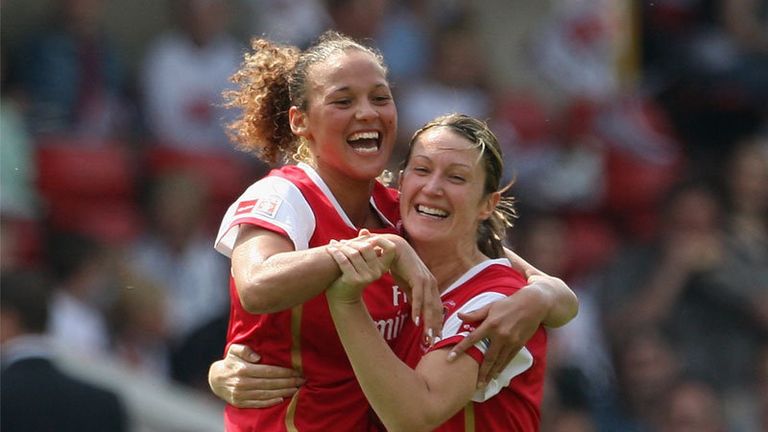
Dan Roan looks at how women's football is still very much a distant second to the men's game.
You've a long, long way to go ladies
I was fortunate enough to attend the Sports Industry Awards last week, a glittering annual ceremony where the great and the good gather to pat each other on the back.
The FA were there, to pick up an award for the work they'd done in promoting women's football this year. Many would argue their prize was richly-deserved; after all, the women's game appears to be booming, with over a million females having now played football of some kind in England.
The number of registered players has dramatically increased from just 11,000 in 1992 to 150,000 by last season, and it's the most popular sport for girls in the country. Meanwhile, a team of Women's Development Officers have been deployed across the County FA's to build the game regionally, building on England's advancement.
The team, marshalled by the inspirational coach Hope Powell, and including fine role models and athletes like Faye White, Rachel Brown, Eniola Aluko and Kelly Smith are now ranked 11th in the world after reaching the quarter-finals of the World Cup last season. Monday's Women's FA Cup final, held at Nottingham Forest's City Ground attracted a crowd of 25,000 people. And champions Arsenal Ladies are the holders of the UEFA Cup.
However, this growth in participation and international success tells just one side of the story. Our fifth
State of the Game investigation revealed that there remains a number of deep-rooted problems with women's football that hampers and holds back its development.
Firstly, there remains a genuine lack of playing opportunities for women, especially once they become teenagers. There are far fewer female teams around the country compared to the provision for boys and men. We featured one former player, Stephanie Bulfin, who gave up football after she found the nearest club to her in West London was forty minutes drive away. She blamed the FA for prioritising the men's game, and argued there needs to be more teams and leagues to cater for the enthusiasm created by girls' mini-soccer.
Development
Secondly, many believe the rule that outlaws mixed football after the under 11 age group must be amended to a higher age. This regulation forces a large proportion of girls to join weaker single-sex teams, where their development is stunted; many then drop out of the sport as a consequence.
North Ferriby United, a mixed under 11's team in Hull have appealed to their local council to help them get round a rule that will force their three promising female players to leave the side at the end of this season. Dave Batte, their coach, was angry that in other countries such as Germany and Holland, selection is based purely on merit, and he believes no such restriction should exist here either.
The FA admitted to us that the rule needs reviewing, and have begun a trial allowing girls up to the under 14 age group to continue playing alongside boys. Laura Dennison is one of the few fortunate girls taking part in the experiment, and insisted that being allowed to play in a mixed team has helped her development as a player.
And thirdly, there's an issue we've tackled before in our State of the Game series; facilities. A worrying 94 per cent of pitches in England lack basic changing facilities or even toilets for women. It's no surprise so many women drop out of the sport once they become teenagers when there only option is to get changed in the car park! Kathryn Hall, of Northants FA, told us that girls football is still bottom of the pile when it comes to investment, and much more spending is required if the game is to grow.
If more girls are to be encouraged to take up football at the grassroots level, the elite end of the sport clearly must play a role, in the form of inspiration. The problem is that the women's game suffers from a lack of profile, TVcoverage and money that the best male players in the country take for granted. In 2000 the FA's then Chief Executive Adam Crozier promised us a professional elite women's league within three years. Eight years have passed and we're still waiting.
The top players in this country are still amateur, having to make do with travel expenses and the odd match fee of £100 a week if they're lucky. When England's women made the quarter-finals of the World Cup last year they were given just £40 a day by the FA for the five weeks they were away.
There have been casualties that would make many girls question whether a career in football is really for them. Take Fulham for example; after hearing the FA's commitment to a pro league, they set up Europe's first professional ladies team in 2000. Having spent £5million on it, the club disabanded the set-up in 2006. Or Charlton's ladies, who suffered a similar fate when their male counterparts were relegated from the Premier League last season. The club saved £250,000 by closing down the women's academy and team; compare that to the £16.5 million it made from Darren Bent's sale to Spurs.
Disbanded
Lorrie Fair, an American player with Chelsea, believes Premier League clubs, awash with cash, could and should do more to help the women's game. She questioned why Manchester United don't have a ladies side (they disbanded theirs in 2004), and pleaded with more clubs to follow Arsenal's lead, who have invested in their female side more than anyone in recent times.
Their all-conquering women's team were recently lent the Emirates Sstadium to clinch their fifth successive title. It was only the second time they'd got to use the ground though, and even then, the attendance was fixed at just 5,000 to save on stewarding costs.
There are other problems with the elite league; the predictability caused by Arsenal's utter dominance does nothing for attendances being one. The fact that it's played in the winter in direct competition with the men, is another. The FA seem to recognise this, and made a commitment to the "possibility" of a restructured elite summer league by 2012, but given Crozier's previous pledge, don't hold your breath.
As with many things in life, it's easy for the status quo to be accepted, and remain unquestioned, simply because it's the way it is, and always has been. But when it comes to the gross inequality that women's football struggles with, it needn't be this way, and it must be challenged.
Despite all the achievements in popularity of the ladies' game, despite it being ingrained in the public consciousness by the film
Bend it like Beckham, it remains a poor relation to men's football. The feeling that football remains the preserve of men remains.
But the fact is that this isn't the case in other sports like tennis or athletics where women enjoy equal billing, prize-money and status. And it isn't the case in countries like China or the USA, where a new pro-league is due to start next year, and where female players are true celebrities, playing in front of packed stadia.
Women's football has come a long way. But it's also got a long way to go.