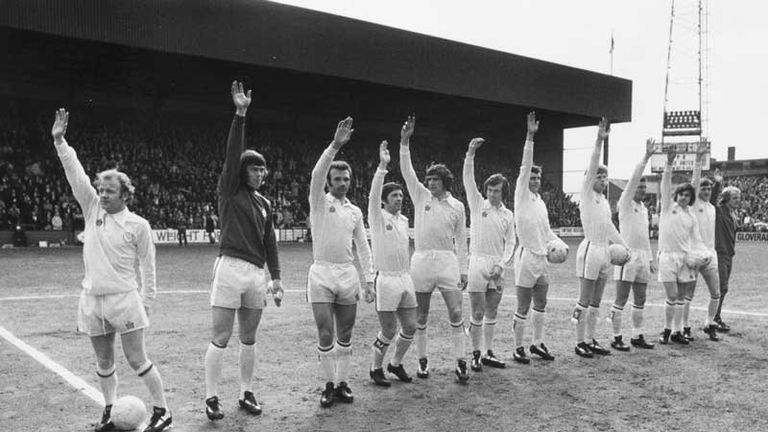
Following the release of The Damned United, Chris Harvey looks at the legacy of Brian Clough's 44 days at Leeds.
The release of the film The Damned United has brought the career of legendary manager Brian Clough into the spotlight once again. The movie gives a partly factual, partly fictionalised account of Ol' Big Ed's 44 days in charge of Leeds United in 1974. The film focuses largely on Clough with the Leeds players merely supporting extras but Chris Harvey recalls a team that should be remembered as one of the best of all time.
Growing up near Leeds in the Seventies there was only ever one team to follow.
I was 10 before a lad moved to the area and started at my school. He was a Liverpool fan - and I was perplexed. Why would anyone want to support anyone other than Leeds?
Back then I was blisfully unaware so many people hated the team I loved - and was even more oblivious as to why - but even as a callow youth I knew appointing Brian Clough to replace Don Revie as manager at Elland Road was always going to end in tears.
On meeting a team full of proven internationals, his first statement was to advise the players to throw away the many medals they have won, accusing them of gamesmanship and winning ugly.
I was baffled. How could somone think that of my beloved Leeds? I had only seen the team robbed of trophies (the 1971 League title and the 1973 Cup Winners' Cup spring to mind) so where did these unsubstantiated claims come from? It was only years later when I heard stories of brown envelopes left for referees that anything made Leeds' Persil-white shirts look more a shade of grey.
In the years leading up to Clough's arrival, Leeds had become the team to beat in English football. The season before they had gone 29 games undefeated from the start of the campaign and coasted to the title at the expense of their heirs apparent Liverpool. The brand of win-at-all-costs football Revie employed to drag United from the depths of the old Second Division had been replaced by a brand of play seldom seen on the mud patches that masqueraded as pitches during the Seventies. Some 35 years later, lovers of the beautiful game still purr about the Whites' 7-0 demolition of Southampton in which Billy Bremner, Johnny Giles and co strung together some 30 passes as they cruelly taunted the Saints to come and win the ball.
Bremner and Giles were central to Leeds in every way. They were the midfield hub around which the team revolved and while some recall their tigerish tackling and gamesmanship, there is little doubt the pair were among the best midfielders of their day.
Conflict
Ironically it was a conflict in the Leeds engine room which led to Clough's arrival at Elland Road and gave rise to the events around which The Damned United is based.
On advising the Leeds board he had accepted the job of England manager, Revie recommended Giles as his successor. After being approached by chairman Manny Cussins, the Republic of Ireland international accepted the job but turned it down when Bremner expressed his anger that he had been overlooked.
When asked about the managerial situation, Leeds legend Peter Lorimer recalls: "John probably made a mistake when, after telling Manny Cussins that he would take the job, he called the lads and told them what was happening. Billy was very upset, thought he should have been in the running and demanded an interview with Cussins.
"When John went into the ground the following day he was told by Cussins that while the offer was still on the table, the board had decided to delay an announcement until the smoke had cleared. John said that they could keep the job, he hadn't sought it and though he was at the time of his career when he had to start to think about the future, in the circumstances he would rather carry on as a player."
Enter Clough. Following a brief and troubled spell at Brighton and Hove Albion he drove into Elland Road brimming with aggression, a sense of righteous indignation and an element of fear. The indignation came from his belief that Leeds had only won trophies through cheating; the fear stemmed from the fact that, for the first time in his managerial life, he was tackling a challenge without his former team-mate and mentor Peter Taylor who had elected to stay on at the south coast.
Taylor and Clough had tasted success at Derby County, picking up the 1972 League Championship ironically at the expense of Leeds who lost their final decisive game at Wolves 2-1 just two days after beating Arsenal in the FA Cup final. It is hard to imagine the likes of Sir Alex Ferguson tolerating such fixture congestion, let alone having to complete their matches using a squad of 14-15 players throughout a campaign fought on four fronts.
Clough needed Taylor and vice versa. After his dismissal by Leeds, the former Derby boss admitted as much, regretting the bull-in-a-china-shop approach he took on his arrival in Yorkshire.
As well as advising the Leeds players to throw all their medals into the nearest dustbin, Clough also told the brilliant but injury-troubled Eddie Gray that if he had been a horse, he would have been shot. He told tough-tackling England international Norman Hunter that he was hated across the land but really he yearned to be loved. Hunter's reply is unprintable.
Such comments were at the root of Clough's failure at Leeds. He had managed at Derby by getting the best out of limited resources, inspiring some average players to incredible heights of performance - how else do you push sides with little football pedigree to the League title?
With Leeds his methods did not work. He did not need to find his own magic formula; it was already in place. He brought in journeymen such as John McGovern and John O'Hare who had done a job for him at Derby and tried to integrate them into a team jam-packed with internationals. And after his verbal tirade on arrival it was little wonder the United players rebelled against this alien style of management after being brought up on Revie's diet of dossiers and carpet bowls.
Sacking
The Leeds players, many of whom had grown up with 'The Don', have steadfastly defended their mentor down the years. Former striker Joe Jordan, now on the coaching staff at Spurs, said of Revie: "In his planning, his knowledge of the game and the way he treated his players, he was the greatest football manager I ever knew."
Indeed Revie left no stone unturned in his match preparations and many believe his managerial methods were years ahead of their time. Unfortunately his legacy at Elland Road began to unravel within months of his departure to the England job.
Following Clough's sacking by the bungling Leeds board - and considerable pay-off - United opted for the relatively safe hands of Jimmy Armfield. The former Bolton boss managed to steer the Whites to the European Cup final in 1975 - a match they lost to Bayern Munich, again in controversial circumstances - but their League performances did not recover from the damage caused by Clough's tempestuous 44-day reign.
The Paris final was the last hurrah for the great Leeds side. The core of the team was ageing and began to break up following the defeat to Bayern. Giles left to become player-manager at West Bromwich Albion still angry at how he'd been treated by the Leeds board while Bremner moved to Hull City a year later.
Armfield brought in the likes of Welsh midfielder Brian Flynn and England international Tony Currie to replace them but they could not lift Leeds to the heights of the Revie era. More managers came and went but in 1982, after appointing Revie old boy Allan Clarke as boss, the Whites slipped into the then Second Division where they remained for eight years.
Leeds' slide coincided with a golden era at Forest and Revie's failure with England as he ran away to the Middle East amid charges of financial impropriety. It appeared the supreme vindication of Clough's talent as he brought back-to-back European Cups to the City Ground.
The closing scenes of The Damned United declare Clough the winner and Revie the loser, but what it could not do, those closest to both men will always swear, was to begin to assess the price of the war.
If Clough had regrets about how things turned out at Elland Road they were, we know, largely submerged in the tides of alcohol that so sadly lapped over the last years of his life.
And Leeds fans will always wonder what would have happened had the club's board taken Revie's advice and persuaded Giles to take the manager's role and continue his dynasty.