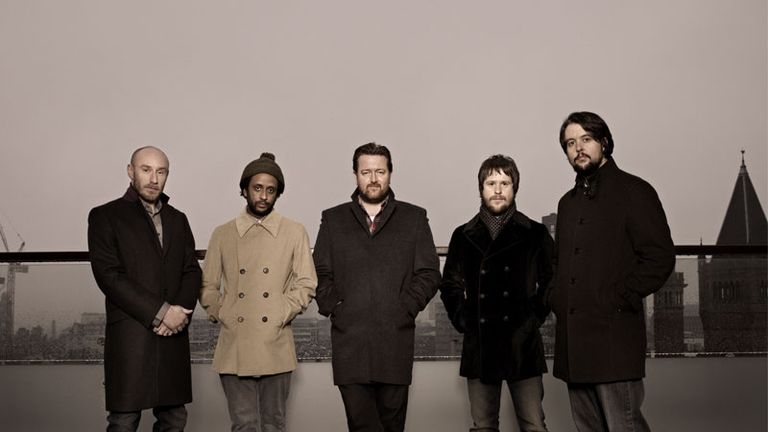
Drummer Richard Jupp talks sport and all things Elbow with skysports.com's Alex Dunn.
Manchester's favourite sons talk sport, along with a host of other topics with skysports.com's Alex Dunn
Given Elbow have been together as long as Sir Alex Ferguson has been at Manchester United it's fair to say they've done the spadework for where they find themselves today.
No longer just Manchester's favourite sons but the whole country's, critical acclaim is finally being converted into commercial success. The luscious Mercury Prize winning
The Seldom Seen Kid granted the band an audience they'd criminally failed to attract despite its three predecessors being hailed as a hat-trick of seminal albums that combined musical innovation with Guy Garvey's lyrical mastery.
Despite their protestations that they're just 'five normal lads from Bury', for the first time with the release of
build a rocket boys! Elbow were no longer underdogs but expected to deliver. Thankfully, given they are universally hailed as the most down to earth and likeable quintet in the industry, they've delivered in style. Although in the middle of an arena tour, affable drummer Richard Jupp took time out to talk sporting soundtracks, among a myriad of other subjects, with
Sky Sports' Alex Dunn.
I'm supposed to be talking to you about football today - but is it fair to say Elbow aren't the biggest sport enthusiasts in music?
We're not the biggest fans to be fair. I'm the dedicated Sporty Spice of Elbow because I like football the most. I used to play quite a bit as a nipper but then got into chasing girls, booze and fags and playing drums. I loved it when I played but just decided to go down a different path.
Who do you support?
I don't really support anyone, a specific team as such, but when there's a good game on I do like to kick down with a beer and watch the footy. To be honest my wife does all the footy in our house, she's a hardened true Blue. I'm a bit of a Blue as well by default.
You might not be the biggest fans, but Elbow's music is constantly being used to soundtrack sporting occasions. How does it feel to hear your music being employed in such a way?
It's amazing. I don't know what it is but it just seems right. It's really interesting to see how your song is going to be interpreted. How they mould tunes to certain aspects of sport is really interesting for us, because obviously we're not sporty in the least ourselves. The way they do it is extraordinary. When you look at it with perspective it's almost as if they add a visceral element to a given track - like when you have
Grounds for Divorce synced to a crunching tackle. It's done us huge favours in terms of getting our songs into the mainstream consciousness.
One Day Like This was adopted as the official tune to soundtrack England's World Cup bid - how did that come about?
It was fantastic. One of the guys on the committee, he might actually be the main guy, is from Bury. There was a natural link there but the track does lend itself to a euphoric occasion - that sense of euphoria and sweeping strings does fit neatly with the campaign. It was an honour to be a very small part of the bid, even if ultimately it didn't win. That was a bit of a bummer but it was great to be part of it all the same.
Do you feel personally responsible for the fact football's not coming home after all?
Absolutely, we're all in tears daily.
From an artistic perspective do you ever feel at odds with how Elbow's music is used on certain television shows? Big Brother?
We've got a really good publisher in Salvation Music/Warner Chappell and we work with Nick Angel, who originally signed us to Island years ago. We've a real personal bond with these people and that's very lucky. They give as much of a s*** as we do about where the songs are going to be placed. With Big Brother, the amount of people that were watching at the time was in the millions, so to have our track on there was brilliant. We do have a certain amount of say but when the opportunity arises it's ultimately down to the publishers really. We have final veto with adverts though, and without naming names we've knocked back a few as it just didn't seem right. In sync land, telly land, it's more open really. We've had it on Top Gear, bloody cooking shows, whatever, but there comes a time when you have to let go - just think sod it, let's just make sure it sounds okay.
You're currently on tour with the new album build a rocket boys! How's that going?
I'm loving it, it's been going really well. It's been an amazing experience, we've got a great crew with us, it looks good, sounds good, no-one's made a right old cock-up as yet, so it's all dandy.
When you played your first gig at the Corner Pin in Ramsbottom many moons ago did you expect 20 years down the line to be doing stadium tours?
We thought it'd be six months before we'd be playing stadiums to be honest. We certainly never envisaged way back then playing two nights at the O2 Arena, selling out the MEN Arena. It's a far flung fantasy and still seems surreal now, even after this length of time. Five scruffy lads from Bury doing this; six trucks, tour buses, big crew, it's ridiculous really. We spend most of our time chatting with the truckers and just having a giggle. When the gigs are on it's serious but before and after it's just ridiculously good fun.
After the best part of 20 years grafting, how did it feel to find yourself all over the magazines, TV and radio pretty much overnight when The Seldom Seen Kid became such a hit?
It's kind of a weird thing. You don't feel vilified because you're actually doing it, living it. You do the press, the cover for Q or you hear the songs on the radio or TV and it's only now, looking back with the benefit of hindsight, that you think 'f****** hell'. You build up to this moment, but before you've got time to contemplate it you're onto the next thing. You've still got to rehearse, you've still got to do the school run, you've still got to go to Tesco.
All the normal stuff is still there but then suddenly I'm on the bus playing on Golden Eye and to my left is the O2 Arena. And it's rammed solid for two nights. I think if you thought about it too much it'd do your head in. You've constantly got things to think about that keep you grounded - I need to sort out the guest list, make sure the wife has got down fine on the train, etc. You haven't really got time to think about all the incredible things that are going on around you. I know I keep banging on about it, but we are just five normal lads from Bury.
So there's no chance the next album will be a coke-fuelled Be Here Now epic, a la Oasis?
Maybe not the next one, but definitely the one after that.
You've always been critically acclaimed but it was only with The Seldom Seen Kid that things went through the roof - was a mass appeal something you'd always craved? How are you finding playing to packed arenas?
On the
Seldom Seen Kid tour it all began to gather pace and we were looking to do Wembley and MEN. It was like, do we really want to do this, the whole arena thing? As you say, we've always been critically acclaimed and there was always going to be a hardcore that we might have lost. People do tend to turn their backs on bands that get to this stage. The main aim for us doing this arena tour was to make them seem smaller, more intimate. By all accounts the two that we did in Manchester on the Seldom tour I felt we were able to make the space between us and the audience seem smaller, to make everyone seem welcome. It was pretty much all down to Guy to be honest. He's an amazing front man, very self-effacing, at one with the crowd just being himself really. It's not a case of you go on, do your stuff, get paid and slope off. It's an all-inclusive experience and we've tried to do it with this tour too.
How important was winning the Mercury Prize in terms of progressing your career as a band?
It was the lynchpin, the cornerstone to the whole thing. Had we not won, it would have just been a longer road. It was definitely the springboard to get into the national consciousness. It made people aware of us who weren't part of our hardcore of fans who'd been with us for years. You could probably tell from our reactions that it meant a lot to us. Nobody knows who has won it, it really is on the night.
Did you feel any added pressure when writing build a rocket boys! given the success of The Seldom Seen Kid?
The only pressure on us was from ourselves to make a good record. We were lucky our label Fiction weren't jumping down our throats to make 12 'One Days' or 12 'Grounds for Divorce'. Of course we realised that we'd have to steer a certain course but only for ourselves. We're the ones who have to play it for two years once we've recorded it so we have to believe in the material. We could have carried on the tour and made a massive go of it but we decided to cut it short in Manchester and end on a high.
This is perhaps the first time you've made an album that some people will have wanted you to fail with given the success of its predecessor? Was this something you were conscious of?
Of course there are going to be people out there going 'what a bunch of wa*****, they've totally turned, they're doing arenas, who the hell do they think they are?' But to be honest, even from the Mercury, there was such a lot of goodwill when we won it. All the press afterwards, I think, were genuinely pleased for us. It was more 'nice one lads' than anything else. We stuck to our guns and I guess it's paid off but in no way are we complacent about anything to do with the music or the shows. You're always going to get some grief but you have to think that you're lucky to be in that position to be paid, able to raise a family, be able to pay the mortgage, the gas bill. All through playing drums, so it's a pretty luxurious position to be in. I'd never take it for granted. You've just got to embrace the old cliché of taking the rough with the smooth.
What was the process for the new album? Was there a germ of an idea from which the rest of the album was shaped?
We went up to Mull for a few weeks. We've got a friend who's got a converted chapel up there. It was just the five us who went there with limited gear, put our heads together, got drunk, cooked, fished and chilled out. It was a bit of a mad time for all of us so it was good just to sit down, relax, and see what came out of it. The track that we came away with was
Jesus is a Rochdale Girl. It's the simplest track on the album. Guy had this poem that he'd written after sitting down after we'd had quite the evening of it. That's the track that really was the basis of the album - the core emotion of the album. It's about looking back, regression, just reflecting on the journey without being cheesy, hopefully.
A lot of the songs on build a rocket boys! seem to be reflecting on the journey you've collectively been on. Why did you choose now to write an album that looks back?
I don't that it was an actively conscious decision to make a retrospective album or anything like that but it was just wanting to make a more stripped down sound, a more stripped down album. Just the five of us without too much embellishment via orchestration or strings. There is a certain amount of that on the album, but perhaps not as much as before. We're all pushing forty now, late thirties, it wasn't an active decision - but once the cogs started working it began to feel right. We're already talking about the next album being a bit more rocky, gritty, but we'll see.
I read somewhere that Guy chose to look back because it'd be hard to write about how he's feeling right now as he's so content? Do you subscribe to the view that the best art is born from struggle?
I think it's all relative to anyone's journey. For us it's been up and down and all around but the central point is that the journey is everything. There's not one point when you can stop and look back as you're continually moving forward. I think Guy's view on the journey is amazing because he takes such a lot from other people. It's not necessarily all his own experience, but rather his interpretation of everything around him. Especially us five because we've known each other for so long and had the same set of mates for so long. It's different people's interpretations as much as his own - good and bad. I don't think you need to suffer for your art though - I think that's a bit of a cop out.
Invariably your sound on the new album will be deemed melancholic - how does that sit with you and why do you think it's a part of so many Manchester bands' make-up?
I think Guy has probably mentioned it before but I think it's probably to do with the weather and the fact it's raining all the time. I really don't know - maybe it's a northern thing. Do southern bands just sing about daisies and sunflowers, as opposed to us with our dark satanic moors? It's just been a point that's been raised that we'll put all Manc bands in that category of being melancholic and a bit sully, offhand. I don't why that is because we're all really happy.
Guy is known for his honesty in his lyrics and I think that's what perhaps people misinterpret as being melancholic because the emotions that he deals with are very real and very tangible. Everybody goes through these feelings of love and loss but we do get lumped into this 'manc miserabilists' label, which was used for us for many years. Even
One day Like This, which is such a euphoric song, had people saying we are still miserable.
Craig Potter, your keyboardist, produced the album as he did the last - how do you find having a member of the band at the mixing desk? Does he increase the volume on all his bits?
We constantly joke about that. There was one tweet that Craig put out that said 'Sorting the mix out today - does anyone want to send me a compliment?'. He's like a machine. He loves the intricacies - the creative side of mixing and producing. It's amazing to see him progress from messing about on a 4-track tape 10 or 12 years ago to producing Seldom initially and now this one as well. It was a case of if it isn't broke, don't fix it. It's great, a real luxury for us, because we do the two side by side. We don't write and then record but do them together. We have to pull Craig away and get him playing because he'd still be at the mixing desk now. We've got it pretty sorted. Craig is in the band and knows our temperaments and when to get the best out of your performance. He's a top lad, top mate and a great keyboardist and producer.
How does the writing/recording process work?
It's a proper melting pot. We have no fixed idea. Mark will come in with a guitar line, a couple of cords, or more often than not I'll just sit and do what we call drum treats where I'll do loops on the kit. Pete might come in with a bassline and it'll kick on from there. Obviously Guy does the lyrics but he's very open to interpretations from us four. He'll have a theme or idea and we'll be like 'let's get a crunchy guitar on it or really heavy drums'. It's great because it all gets a bit Blue Peter in the studio where we'll go looking for sounds that can equal the emotion of the lyrics or the theme of the songs. If anyone comes up with an idea we'll run with it. Every couple of months we'll have a bit of a cull, sort the wheat from the chaff and then slim it down from 30 ideas to 25, then the final 11 or 12 tunes that appear on the final album.
In the time that you've been together some bands have formed, broken up and done a reunion tour. How have you managed such longevity?
Because we're mates. We find each other hilarious. We find each other more funny when we're all hung-over, when we're delirious with jetlag. We just enjoy each others company. We make each other laugh but on the other side of that we've known each other for so long that we know which buttons to push. If someone is having a turd of a day we know to make them a brew and give them a bit of space. We all absolutely respect one another's abilities as musicians. We're all, bar Guy, fathers - so there's that responsibility that we also share. Guy's almost a father to all our kids anyway, he's the uncle, a dodgy one but not quite the dodgy uncle at the wedding. We've huge responsibilities but yet when we get together it's still let's get a beer, chill out and have a laugh.
"Success" has come later for you than for many bands - in hindsight do you think it's been easier to deal with given you're a little older?
I think age does put a bit perspective on the term 'success'. It's an objective thing - people say you're successful now but without sounding trite, we considered it 'success' when we signed our first deal. We still remember that and still think it's amazing. But we have to put more into our shows now to put our mark on them. We're still working on it but it's great sitting outside the O2 rather than a tiny venue when I'm 37.
As you say the band have different responsibilities than when you first started. Is it sometimes difficult to gear yourself up to go on another tour?
Not at all. We're doing arenas now so we're still at the stage where we look at each other and say 'Christ, how did we get here?'. At the start you have to get into it, the whole touring lifestyle. Your body clock is all over the place. You're doing most of your work at night but we've amazing support from our families. I've been with Sarah my wife for 12, 13 years. She's been with me from before the start and she's seen the whole progression and she's still here so I must be doing something right. The kids are actively involved, they come to sound checks. Dylan, my little boy, came on tour with me for the first time to Sheffield and Liverpool and absolutely loved it. I think it's nice that we're very open about how we do it. It's not a case of now we're on tour, now we're in the studio, so we won't see you for three or four weeks. We're at the stage where we can get our families out to where we're playing so it's not just a celebration for the five of us, but for everybody.
Can you see yourself going back to doing scaled down gigs again?
Once we get back to Europe next week we'll be doing smaller venues again. I'd love to do a tiny theatre tour again though, maybe on the next album we might try something different. It might be like when we did the gigs with the Halle for the last album, that was very much outside of our comfort zone. They were incredibly successful and did us proud but we would like to do smaller tours again. Hot and sweaty, a down with the kids sort of thing.
So what's next?
We'll be cracking on. It's probably going to be 18 month to two years until the next album. We'll finish this tour, then gigs in Europe before Coachella and then festivals. It's all over the place, a little bit in Australia too, but really it's about the festivals in the summer. We've always talked about doing a film score and we might look into that in the future. We're obviously not a big radio band over in America but we have been there a couple of times. We're doing Coachella this year so will do some gigs in LA before then. I think we want to concentrate on Europe at the minute - it doesn't overly concern us that we're not massive in America but if the time was right we'd think about going over.
Following the immense success of the double platinum selling 'The Seldom Seen Kid', Elbow have released of their fifth studio album, 'Build A Rock Boys!', available to buy here.