From Tomas Brolin to Peter Taylor via a stop-off at Pro Vercelli, Daniel Storey asks what happened to those who seemingly had it all but dropped off the radar in the blink of an eye...
Tomas Brolin
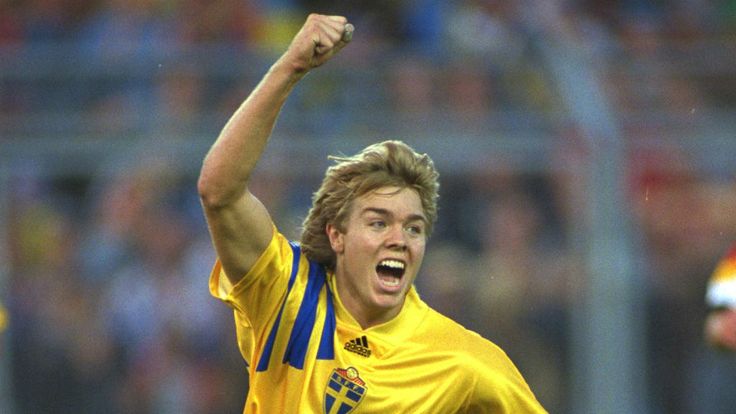
The decline of a player that had everything aligned for a successful career and a typical tale of just too muchery. Scorer of the famous goal that beat England in Euro 92 aged just 22, Brolin was an integral part of a Parma side that won the Coppa Italia, UEFA Cup Winners' Cup, UEFA Cup and Super Cup within a four-year period. At the point at which he was sent to Leeds all appeared rosy, but an irreversible decline was instigated almost from the moment he arrived on English shores.
He started only 20 Premier League games at Elland Road as he began to notoriously put on weight, wonderfully describing his selection on the wing as being "asked to run up and down like an idiot". After loan moves, the Swede wound up at Palace with a great deal of added timber before retiring in the same year, aged just 29.
He wound up owning a shoe shop back in Sweden, from where he is attributed with the following quote: "From a young age I felt like my mission in life was to make shoes." Leeds and Palace fans may agree.
French National Team
From the highest high to the lowest low. After winning the World Cup and European Championships between 1998 and 2000, French football had reached its zenith, as past underachievement had finally been put to bed in style.
Two years later, and all had crumbled. Travelling to South Korea and Japan in 2002, Zinedine Zidane, Patrick Vieira, Thierry Henry et al performed woefully, failing to score a single goal during defeats to Senegal and Denmark and a draw against Uruguay, finishing bottom of the group - the first time the holders had suffered such ignominy.
Does the rut still continue? Whilst it would be churlish to overlook their final appearance in 2006, the victories over Spain and Brazil in that tournament remain their only knock-out victories since their Euro 2000 win. That's six tournaments of football (and the same number as England).
Ricardo Quaresma
Whilst most players would kill for a CV that reads Sporting Lisbon, Barcelona, Porto, Inter and Chelsea, the downfall of one of Europe's supposed next superstars has been marked.
Quaresma was bought by Barcelona as an intended replacement for Luis Figo, but after a fall-out with manager Frank Rijkaard (a hallmark of the winger's career) he was sold back to Porto for €21million, impressing enough to earn a move to Inter in 2008.
But in the last five years things have deteriorated rapidly. Given the Bidone d'Oro award for Serie A worst signing in his first season, Quaresma had an unsuccessful loan spell at Chelsea before Besiktas were persuaded to pay €7m for his services.
The Turkish side were so underwhelmed that they terminated Quaresma's contract six months before its completion, and he was last seen being given a 20-minute run-out off the bench for Al Alhli in UAE last weekend. Quaresma is still just 29.
Peter Taylor
It is rather easy to forget just how close Taylor came to managerial success. Whilst his appointment as England manager was merely on a caretaker basis, it does demonstrate Taylor's reputation at the time, and in October 2000 his Leicester City side were top of the Premier League, their boss having won Manager of the Month for the September.
Less than ten months after his England tenure, Taylor had been sacked by Leicester with the club sat bottom of the table. After spells in the third tier with Brighton and Hull the now 60-year-old finally gained Championship employment at Crystal Palace, but was sacked after less than 16 months.
Taylor's fall from grace is now almost complete. After leaving Bradford City he was sacked as manager of Bahrain last year, and now coaches England U20s, a side who have not played a competitive match since August 2011.
Pro Vercelli
It's a quiz question gem. Name an Italian club that has as many Serie A titles as Napoli, Roma and Lazio put together? If your answer was Pro Vercelli, give your football-ravaged brain a shiny penny.
Between 1908 and 1922 Pro Vercelli won seven titles - even more impressive when the interruption of the First World War is taken into account. This was largely thanks to the goals of Silvio Piola, one of Italy's greatest strikers.
The Leoni's downfall was initiated by the sale of Piola to rivals Lazio. By 1935 they had been relegated to Serie B, and five years later to Serie C. Only last year did Pro Vercelli finally gain promotion back to Serie B after 64 years below the second tier. They look set to be relegated at the first time of asking. That quiz question looks in serious danger of being annulled.
River Plate
Everything about River Plate indicates a club at the very top of its sport. Winner of 34 titles and a cluster of international honours, housed in the vast bowl of El Monumental with its 67,000 capacity and sharing a rivalry with Boca Juniors that is surely the most passionate in the game.
But in 2008 fortunes faded remarkably. After the resignation of Diego Simeone, River finished bottom of the Apertura for the first time in their 107-year history. Argentina's system of relegation (where demotion is calculated on a three-year average) merely prolonged the agony, and in June 2011 they were forced to play-off against Belgrano de Cordoba, with the loser playing Primera B football the following season. Such was the feeling of shock and raw anger after River's defeat that there was rioting in the stadium and surroundings.
To say that this is the equivalent of Manchester United being relegated over-simplifies the cultural intricacies of Argentinean football, but it was undoubtedly South American football's biggest fall from grace.
Stefan Moore
Whilst Englishmen such as Francis Jeffers, Michael Bridges and Lee Hendrie certainly merit discussion (along with many more), they were all still playing at League One level or higher at the age of 32, which just isn't a big enough fall to warrant inclusion.
For the truly complete domestic drop, Stefan Moore is virtually unrivalled. Still only 29 now, Moore never really got a look in at Villa Park after signing a new three-year deal in 2003 despite being highly regarded, but loan spells at Chesterfield, Millwall and Leicester City also passed by without a goal being scored, and he eventually joined QPR on a free transfer. Walsall and Kidderminster were the next destinations before Halesowen Town, St Neots Town, Leamington and now Brackley, who he joined this summer.
That Moore's younger brother Luke, initially less highly rated than his sibling, is now scoring goals in the Premier League shows the significance of Stefan's regression. A BBC article from 2003 on the 'Premier League Young Guns' picked Moore alongside Wayne Rooney, stating that the striker was "tall, quick and good on the ball, with all the attributes needed to succeed in the Premiership". Poignant inaccuracy, I'm sure we can all agree.
Stade Reims
Whilst Real Madrid's victories in the first five European Cup finals established themselves as a giant of European football, the beaten opposition in two of those games have fared dramatically poorer.
Stade Reims were the driving force of French football for two decades following World War II. Manager Albert Batteux was hailed as a coaching genius as the relatively small-town club won six titles and seven domestic trophies between 1949 and 1962, and would have beaten almost any other club than Real in those two finals (even taking a 2-0 lead in 1956 before Alfredo di Stefano took centre stage).
The departure of Battteux crippled the club. In one year they went from second in Ligue Un to second bottom and were relegated, and although they are now back in the top tier, have never come close to completing such remarkable feats.
Manchester City
A City-supporting friend of mine describes his first love as "the only team that can always snatch defeat from the jaws of victory". Whilst that is a feeling that we all share on some level with our clubs, it is certainly true that their fans could for so long file themselves under 'long-suffering'.
Sixty years before their crumpling into the Second Division in 1998, City fans got their taste of rain after the sunshine. In 1936/7 they scored 107 goals as they won the First Division ahead of Charlton. The following season, they still scored the most goals in the division but somehow contrived to get relegated, finishing just five points behind tenth-placed Chelsea and 14 points off champions Arsenal.
It remains the last time the champions of the top tier have been relegated the following season. That's worse than Gareth Taylor and Tony Vaughan in Division Two.
Denilson
There was never any question that Denilson's fee for his move to Real Betis from Sao Paulo was inflated (a world-record £21.5m), but there should be no doubt that this was a talented player, winning 61 caps for the Selacao and a World Cup winner's medal.
With that in mind, there can surely be no player with a greater fall over a remarkably short space of time. Finally leaving Betis in 2005 (but aged just 28), Bordeaux signed the Brazilian winger, but he lasted just one season in France.
In the next three-and-a-half years Denilson then moved to Al Nassr (Saudi Arabia - two months), FC Dallas (USA - five months), Palmeiras (Brazil - twelve months), Itumbiara (Brazilian second tier - three months), Xi Mang Hai Phong (Vietnam - six months) and Kavala (Greece - two months), after which he retired after failing to be selected on even one occasion by the Greek second division side. He was just 32.
NB - Don't believe reports of him playing in Uzbekistan or South Korea. This is simply the mixing-up of one well-travelled Brazilian Denilson for another.
This article first appeared on
Football365