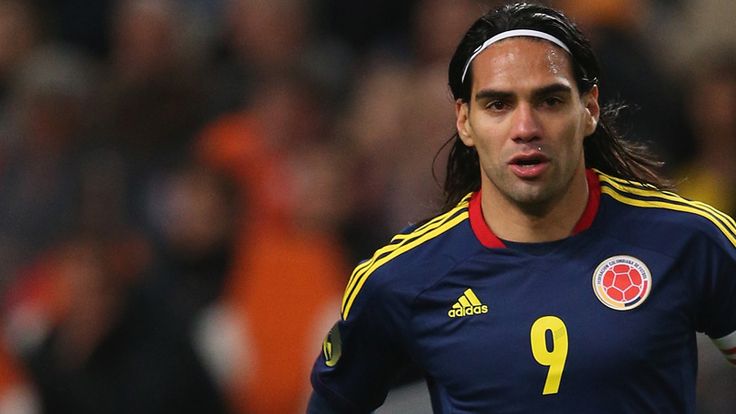
Radamel Falcao's injury may have dampened expectations in Colombia ahead of the World Cup but boss Jose Pekerman has built a fine side
CLICK HERE to find out why there is more to 2014's Dark Horses than a famous forward
What is the mood in Colombia ahead of this World Cup? Is there cautious optimism? They've been stung before...
Understandably it's one of excitement. Colombia haven't been at a World Cup for 16 years and after a strong qualifying campaign there are high hopes the country could do well. It's rare to turn on a Colombian TV or radio station at the moment without seeing news of the national team and only last week Fifa issued a press release showing Colombians had bought more World Cup tickets than any other nation except host country Brazil and the US. I think that goes to show the level of interest Colombia has towards the tournament.
But the effects of what happened 20 years ago when Colombia arrived at the World Cup in the US as one of the favourites before crashing out in the first round still hovers over both the team and country. The murder of Andres Escobar, Colombia's star defender who was shot dead on a nightclub car park just ten days after scoring past his own goalkeeper in the finals, left an indelible legacy. Football wasn't to blame for his death, but if he hadn't scored that own goal, he would probably be alive today.
Many comparisons have been made between the current side and that from 1994 and I guess it's understandable in one respect; both these teams feature some of the finest Colombian players of all time. But there are far more differences than similarities. Back then it wasn't just the drug cartels who were meddling in team affairs. Businessmen, player agents, journalists, the football federation and many other powerful interests were using the team as a vehicle to promote their interests, while squad discipline was laughable.
This time, however, manager Jose Pekerman has gone out of his way to protect his team from repeating errors made during that dark chapter. He finished his playing career at Medellin side DIM during the 1970s and so understands a bit about Colombia's troubled history. He also has a Colombian daughter who made one demand when he was unveiled as Colombia manager in January 2011: Get us back to the World Cup finals.
How was the news of Radamel Falcao's injury received?
People knew from the moment he was taken off during that French cup tie that the injury was serious, but when it was confirmed he was likely to miss the World Cup it was a huge shock. Alongside Carlos "El Pibe" Valderrama Falcao is perhaps Colombia's greatest player of all time and so for Colombians who have spent almost two decades watching the World Cup finals from the sidelines, it's a huge blow.
But being a deeply religious country and knowing Falcao is also a devoted man of the church, a lot of people have since found solace in believing faith will work its magic in dragging him to Brazil. A bit like in 2002 when Brits were asked to rub a picture of David Beckham's foot and pray for divine intervention, Colombia went down a similarly bizarre path. Adverts of random people chanting "I believe" were splashed across TV and in Falcao's hometown Santa Marta 300 churchgoers gathered for a special mass where Radamel's photo replaced that of the Virgin Mary.
Games in the national Colombian league featured teams unveiling pre-match Fuerza Tigre [Stay Strong Tigre] dedications and wherever you go it's a popular way of starting conversation. It remains to be seen whether blind faith or the wonders of modern medicine will help Falcao recover, but at 28-years-old Falcao is in his prime and it would be a great shame, not just for Colombia, if he were to miss the tournament.
Do they have the players to adequately replace him? Can you discuss a few of the key names and how they are perceived by Colombians...
Ten years ago Colombia had a plethora of very good defenders like Mario Yepes and ex-Inter man Ivan Cordoba, and very few top quality strikers. Now it seems to be the other way around. Falcao is the team's star and Colombia's all-time second top goalscorer and so there's obvious concern, but there are also plenty of decent back-up options.
Jackson Martinez is probably the favourite to replace El Tigre on the back of his incredible goal-scoring record at club side Porto. He's a natural finisher who's good with both feet, strong in the air and would probably be first choice for the vast majority of countries in Brazil. His problem is that he is probably a little bit too similar to Falcao and so has been given limited opportunities for the national team. While Pekerman has tried fielding both strikers together it hasn't proved a great success and so Jackson has had to make do with coming off the bench. If he is Colombia's main striker this summer it's worth noting he failed to score in any of Colombia's qualifiers.
Other candidates include Carlos Bacca who was top goalscorer in Belgium in his first full season in the Jupiler league before a move to Sevilla. He's already scored ten goals and was voted La Liga's best summer buy, but again he's had little playing time for the national side and has so far only scored in friendlies.
Victor Ibarbo was recently called up to the squad for the Belgium and Holland friendlies and made a huge impact when coming on as a sub. He's more of a high winger and has a playing style similar to Tino Asprilla with lots of pace and power. He's unlikely to start but could be quite the asset coming off the bench.
Elsewhere, despite recently going off the boil Freddy Montero made a blistering start to his Sporting Lisbon career and Pekerman has confirmed he's keeping tabs on him. Adrian Ramos is top goalscorer in the Bundesliga with Hertha Berlin and is expected to receive his first call-up under Pekerman for the upcoming friendlies, while 22-year-old forward Luis Muriel has been a regular in the squad and considered an exciting prospect.
But while there are lots of strikers jostling to be part of Pekerman's final 23-man squad, the biggest problem is the system. Before Pekerman, Falcao hadn't really shone for Colombia where he was starved of service and struggled to adapt to the defensive tactics of previous coaches. But one of the changes Pekerman made when he took over was to look for a strike partner who could open up space for Falcao. Tall, strong and good with his feet, Teo Gutierrez was the perfect fit in dropping deep and dragging defenders out of position. They quickly formed a lethal partnership and contributed to more than half of Colombia's goals during qualifying. Without Falcao though, it's unclear whether Pekerman will see Teo as being as essential, especially considering the poor form he's in for club side River. But even more importantly than the change of personnel is the tactical rethink Pekerman must now consider with the World Cup just three months away.
Is Jose Pekerman a popular figure? Is he doing a good job?
It's election year in Colombia and president Juan Manuel Santos is the favourite to win a second term in office. Opinion polls, however, regularly show a huge majority (as much as 70 per cent) against him seeking re-election. In fact it's the blank vote, a protest action rejecting all candidates that could emerge as his nearest challenger. It's clear that Colombians do not trust their politicians.
Jose Pekerman, on the other hand, holds approval ratings far exceeding any politician. During Colombia games 'Pekerman for President' banners are regularly seen in the stadium with T-shirts of Pekerman mocked up in a Superman costume also being a fan favourite.
But when he took over as manager Colombia were in a mess. They had taken just one point from their first two home qualifiers and were on their third boss in three months. During crunch talks held with the Colombian FA in Miami, the Argentine made one important demand if he was to agree to become manager: to be given complete control over all aspects of the team. It was something that had never been entertained previously. But the federation were desperate.
Pekerman's influence wasn't immediate and over the first few months he was heavily criticised because nobody knew anything about him. He never gave press conferences, refused to speak to journalists, locked the media out of training sessions and when Colombia lost against Ecuador in his second game in charge, quite a lot of people wanted him out. But Pekerman learnt a lot from that defeat and from then onwards Colombia's turnaround was quite astonishing.
With 30 points they finished the South American qualifying heat as runners-up behind Argentina, which helped secure Colombia a place as group seeds for the first time. Even more than Falcao, Pekerman is the reason Colombia are in Brazil.
What would represent a good World Cup? Does it help that the tournament is in South America?
Reaching the quarter finals for the very first time is the big goal. Colombia crashed out at the group stage in their last two World Cup final appearances - USA '94 and France '98 - and if that were to happen again it would surely be seen as another flop. If we consider the relatively easy group they've been drawn in (Greece, Ivory Coast and Japan) and the fact that Colombia haven't dropped out of the top ten Fifa World Rankings for the last two years, the second round is the minimum expectation.
One of their main strengths will be playing the World Cup in South America. During qualifying most of their home games were played under the boiling afternoon sun in Barranquilla, a really hot and sticky city where temperatures can soar to the high 30s. Under Pekerman they won five and drew one game as hosts and even more impressively finished the 18-round South American qualifying stage as the country with the best away record. So I think it's fair to say Colombia will be one of the countries that copes best with Brazil's tricky meteorological challenges.
If you can give us your best guess at the starting line-up that'd be useful too...
All depends on injuries and what happens over the next couple of months. As well as Falcao, Zuniga has been out injured since October, Armero hasn't played much since joining West Ham and Macnelly Torres's place is under threat after moving to play in Saudi Arabia.
But, if Pekerman sticks largely to the side that was so used successfully in qualifying, it will probably look something like this:
You can follow Carl Worswick on Twitter by clicking here