Analysis
Man City Premier League charges: How 'disguised funding scheme' changed the football landscape - Between the Lines
Man City are found to have artificially inflated their revenues by £830m using "sham" commercial agreements between 2009/10 and 2017/18; Between the Lines explains how the financial breaches facilitated huge transfer spending and changed the football landscape
Wednesday 30 September 2026 14:27, UK
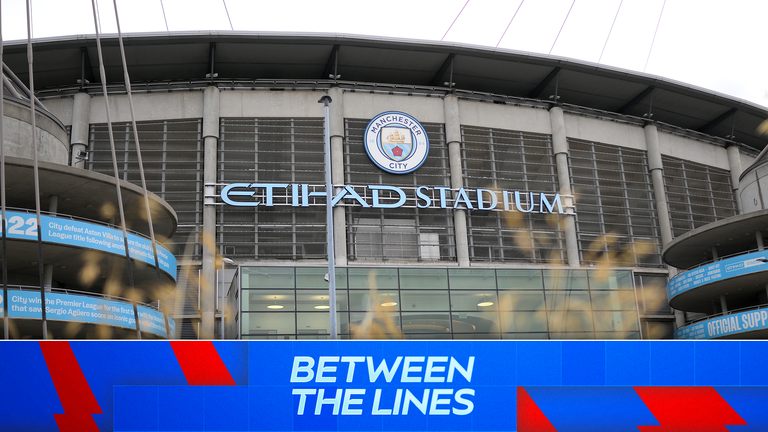
When Sheikh Mansour completed his takeover in September 2008, marking the start of his ownership with the sensational and then-record signing of Robinho from Real Madrid, Manchester City were a club with two top-flight titles in their 114-year history.
The last of those titles had come four decades earlier. City had just finished the 2007/08 season in ninth, 32 points behind champions Manchester United, having suffered an 8-1 loss to Middlesbrough in what proved to be Sven-Goran Eriksson's final game in charge.
City had been relegated three times in the Premier League era, dropping as low as the third tier only 10 years earlier. The previous 16 Premier League titles had been shared between Manchester United, Chelsea and Arsenal. City were not in the picture.
Few could have predicted the extent of the transformation that followed. In the nine-year period covered by the Premier League's investigation, City won three Premier League titles, more than doubling their previous tally. A new superpower had emerged.
- Man City charges verdict - latest news and live updates
- Jamie Carragher: Man City should be stripped of titles
- Ferran Soriano: Process a 'Premier League conspiracy theory'

But behind their unprecedented rise, an independent commission has determined there were serious breaches of financial rules.
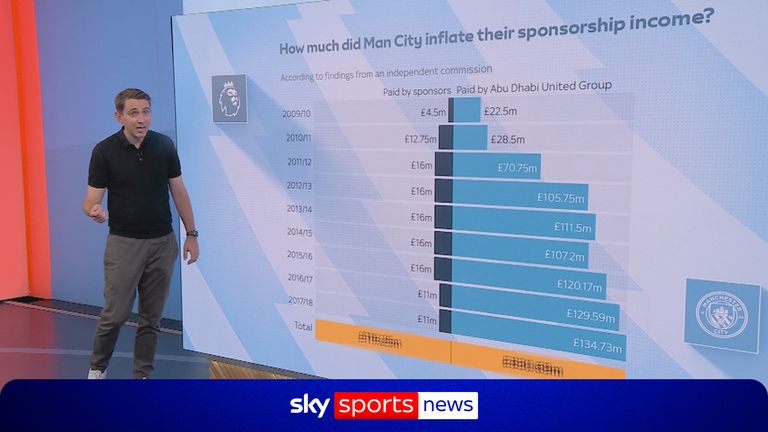
Their findings include "sham" contracts with commercial partners and the artificial inflation of revenues by £830m. Possible sanctions include fines, transfer bans and expulsion from the Premier League. Some are calling for their honours to be stripped. City deny all wrongdoing and intend to appeal the decision.
The "disguised funding scheme", as it is described in the commission's report, involved City's Abu Dhabi United Group owners paying huge sponsorship fees that were recorded as commercial revenue, helping City embark on an unprecedented era of spending.
Between the summer of 2009 and the 2018 January transfer window, the club spent £1.2bn on players, according to Transfermarkt data - nearly £300m more than next-highest spenders Chelsea on £931.7m. City's net spend of £888.2m dwarfed that of next-highest United on £513.1m.
The extraordinary extent of their spending can be seen on a year-by-year basis too. City ranked top for transfer spending among Premier League clubs in five of the nine seasons covered by the investigation, and ranked top for net spend in six.
The club signed a succession of the world's best players during the period, many of whom played crucial roles in the club's subsequent successes, starting with their first title win in 44 years in 2011/12.
In the two seasons before that historic triumph, when spending totalled £260.5m, the incomings included Carlos Tevez, Edin Dzeko, Yaya Toure, David Silva, Mario Balotelli and James Milner as City began to lay the groundwork to become challengers.
Sergio Aguero, Samir Nasri, Fernandinho, Jesus Navas and Eliaquim Mangala were the headline arrivals in the subsequent four seasons, before spending ramped up again in 2015/16, when their new recruits included Kevin De Bruyne and Raheem Sterling.
The highest-spending season of the investigation came in 2017/18, when City won the third of the Premier League titles in question after committing £282.5m on players including Aymeric Laporte, Benjamin Mendy, Kyle Walker, Bernardo Silva and Ederson.
At that point, the sponsorship fees being paid by the Abu Dhabi United Group had increased for four consecutive seasons, reaching £134.7m in 2017/18, up from £22.5m in 2009/10.
The £830m falsely recorded as commercial revenue between 2009/10 and 2017/18, according to the commission's findings, equates to roughly 70 per cent of City's £1.2bn transfer spend.
In the same period, they were able to attract a trio of elite managers in Roberto Mancini, Manuel Pellegrini and Pep Guardiola, all of whom benefitted from the club's transfer spending.
City won an FA Cup, three League Cups and a Community Shield in addition to their three Premier League titles, making it the most successful period in the club's history.
The graph above, showing the club's finishing positions over the course of history, highlights the pivotal nature of the period in question, showing City's clear emergence as a dominant force in English football, a position they have retained subsequently.
Manchester City, who finished in mid-table when Sheikh Mansour completed his takeover in 2008, have since seen their fortunes transformed, finishing outside the Premier League's top three just once in the last 16 seasons.
Now eight-time winners, City rank behind only Manchester United for Premier League title wins, having overhauled Chelsea and Arsenal in the rankings. Factor pre-Premier League title wins and they are one of only four clubs, along with Manchester United, Liverpool and Arsenal, to have reached double figures.
But the commission's findings, covering the transformative period between 2009/10 and 2017/18, put their achievements, and the changing of football's landscape, in a harsh new light.