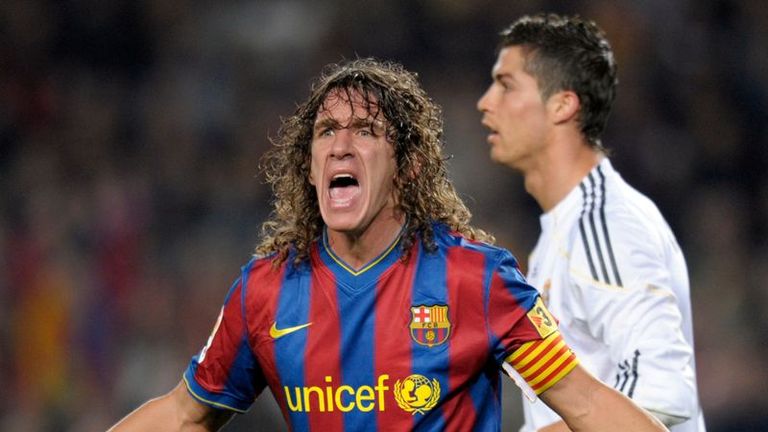
Guillem Balague looks at this weekend's El Clasico, and knows who British fans will be supporting...
Barcelona have won battle for hearts and minds before a ball is kicked
The British have an obsession with football and war: it's impossible to talk about one without falling back on metaphors from the other. It's a habit that's hard not to pick up while living on this island and to be honest, one that is repeated also in Latin countries.
But let's stay in Britain. For example, you like to say that the face of modern warfare has changed, that it's now a battle for hearts and minds rather than good old fashioned territory and resources.
Football has gone the same way as well, and now it's no longer deemed enough to simply beat your opponents, as any of the marketing men will tell you, it's vital you win over a few hearts along the way.
The British do have a fascination with the clashes between Barcelona and Real Madrid and it's precisely because it fits very nicely into your 'football is war' obsession. You love the rivalries, the derbies and the contest between Spain's two biggest clubs is appealing because British audiences have been able to frame it in very simple binary terms.
Popularity stakes
Yet in the battle for hearts and minds, this season's clash at the Bernabeu is a one that Barcelona have won before a ball has been kicked. For a very long time it's been as simple as: Barcelona good, Madrid bad. But unfortunately for Madrid, while they may have started to regain ground in the Beckham era their actions and performances over the past 12 months have made them runners-up in the popularity stakes once again.
Maybe the British preference for all things Barça can be traced back to the civil war and the volunteers who signed up to the international Brigades fighting with the Republicans, to the old alliances and allegiances of the Second World War - the stereotypes have led the British to oppose Madrid. While the propaganda from Barcelona has successfully fuelled the mythology, Real Madrid have never really had an answer.
Maybe, for the generation of sportswriters and commentators today, their affinity for Barcelona was fuelled by the likes of Lineker, Venables and Robson representing the Blaugrana. And while it's true that Madrid had Cunningham and Toshack, neither enjoy the same levels of universal affection as the aforementioned trio. Maybe it has something to do with the millions of British holidaymakers who have packed the Costa Brava for generations, whose trip to the Camp Nou museum on a childhood excursion sparked their preference for Barça as their second team.
Stereotypes
It's been perpetuated by British writers and artists ever since who have continued to rely upon the old myths and stereotypes of the roles that both clubs occupy in the British imagination. Even those British authors who have done an excellent job in exploring the issue beyond the usual superficial treatments of a complex issue have discovered that Barcelona's elevated standing is hard to dislodge - hence the fact that two excellent books on Real Madrid by John Carlin and Phil Ball have never matched the sales of Jimmy Burns' book on Barça, despite being better balanced.
Madrid's individual stars have secured them fans and help to sell shirts all over the world, but they've never managed to corner the market in terms of affections in quite the same way Barcelona has.
Over the past 12 months, Barcelona have really surged ahead in the PR battle. While Real Madrid have few friends in Manchester and Liverpool following their pursuit and acquisition of Ronaldo and Xabi Alonso, Barcelona have been lapping up the praise for producing their own talents. Florentino Perez's spending is perceived as a threat, yet as long as Barcelona spend their millions outside the Premier League, somehow it doesn't matter. Perhaps if Ibrahimovic had played for United it would be different.
Eulogising
And if anyone ever doubted how important success in the Champions League means to a club's profile beyond the domestic market, look no further than reaction in the British press to Madrid's elimination at the hands of Lyon, compared to the widespread eulogising of Barcelona's performance against Arsenal. All the praise heaped upon 'the club of choice for the Romantics' - as The Times called Barcelona - for their 'beautiful football' and 'exemplary philosophy' is in stark contrast to the universal criticism of Real Madrid.
And since the Lyon fiasco we've heard nothing of Madrid in the British press. There is a fascination with El Clasico but the clubs' participation in the Champions League is what assures a continued presence in the British media. Which is why Barcelona have been winning that battle too. Madrid could win the league but it's seemingly irrelevant here.
In an article in The Times last week, praising Barcelona's output from La Masia, the author stated that 'only Raul and Casillas are worth mentioning as graduates from Madrid's youth academy in recent years'.
As I overheard one Arsenal fan say to another in a pub outside the Emirates last week: "Barcelona will be tough, they're top of the table in Spain. It's a shame we're not playing Madrid, they're having a bad season." Both have of course have the same points and the winner of the game on Saturday will win the league. However it's not the truth that counts, but the perception, and on that front Britain has already selected its winner at the Bernabeu.