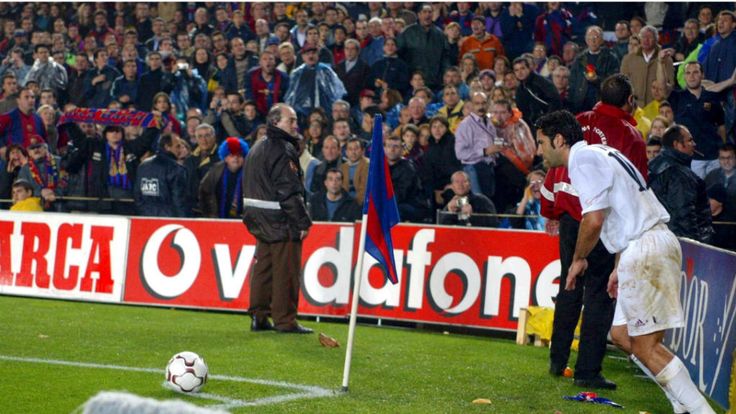
Ahead of El Clasico on Saturday, Sid Lowe discusses his new book about the famous rivalry.
Premier League fans are used to rivalries such as the one between Manchester United and Liverpool where the differences are quite nuanced. In comparison, these two teams are really juxtaposed historically aren't they?
Yeah, that's true of a lot of Spanish teams and is one of the things that interests me about the game in Spain. Every team is seen to represent something. For example, to use that example of Manchester United and Liverpool, a Spaniard would always ask which one is the real people's team, which one is the working class team. They want to know what the teams represent because they're very conscious of that identification. It stretches to all Spanish clubs but, of course, nowhere is that more powerful than in the case of Real Madrid and Barcelona.
Although part of the point of the book is to try and show the nuances and show the bias and the myths in the popular conscience of it, there is no denying that it is seen as this battle between democracy and fascism, a fight between the centre and the periphery, between Castilian and Catalan. It creates a very clear narrative that makes it really quite seductive.
On top of everything else they are probably the two biggest and best clubs in the world with the two best players in the world and the two richest clubs in the world, with only Manchester United perhaps ahead of them. So you have this rich symbolism and added to that you've also got the best football that there is.
You mention that there are certain myths associated with the rivalry. Did your view of the clubs change a little through the process of researching the book?
A little bit. It's strange really. During the research, you expect your perspective on them to shift. But in a way, what did change is that I became more clear-minded in my own perspective that the general assumptions about the two clubs needed to be challenged and possibly needed to be challenged even more powerfully than I had initially thought.
I had always rejected this simplistic notion of Barcelona being the freedom fighters and Madrid being the Francoist team. I'd always rejected the notion of it being as simple and clear-cut as left against right, although there are elements of truth to that. So my perspective probably didn't change but it is true that through the research, digging through the archives and talking to people, I became clearer in mind that these things needed to be challenged more head on than I'd anticipated.
The book discusses the symbiotic nature of the relationship between the clubs. To what extent do you feel they need each other and are defined by each other?
Obviously, the nature of the rivalry shifts over time but Real fans will always say that one of the key facets of the rivalry has always been that Barcelona are obsessed with them. Real will claim they aren't so bothered because they're too big to be bothered about them. And Barcelona players of a certain era would agree with that. They'd say that they were obsessed with them. That they were defined by the fact that they were their victims, the downtrodden ones with Real always being favoured by referees.
But one of the things that's really clear on this is that in the last 20 to 25 years, that has shifted slightly. This idea that Real Madrid are not really bothered by what Barcelona do is just not true. They both define themselves against each other as well as what